
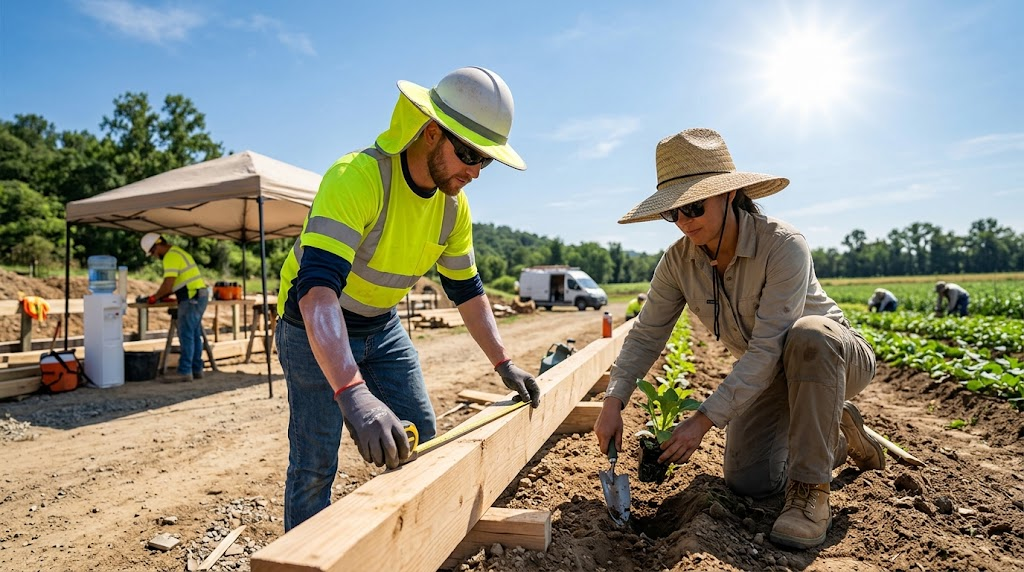
Tradies, farmers, lifeguards and delivery drivers spend far more time under direct sun than the average office worker, yet workplace sun protection is often treated as an afterthought rather than a core part of workplace safety.
Why Outdoor Occupations Carry Higher Risk
UV exposure accumulates over a working lifetime, and outdoor workers can receive several times the annual UV dose of someone working indoors. This cumulative exposure is one of the strongest predictors of skin cancer risk, regardless of skin tone.
Unlike a weekend at the beach, occupational sun exposure happens repeatedly across decades, often during the middle of the day when UV levels peak, which compounds the risk considerably over time.
Occupations With the Highest Documented Exposure
Construction workers, agricultural workers, gardeners, and postal or delivery workers consistently show up in research as having some of the highest occupational UV exposure levels in Australia.
Risk by Occupation
| Occupation | Typical Daily UV Exposure Pattern |
| Construction and roofing | Extended midday exposure, often with reflective surfaces nearby |
| Farming and agriculture | Long hours across all seasons, frequently with limited shade access |
| Lifeguards and pool staff | Extended exposure at the times of day when UV is most intense |
| Delivery and postal workers | Repeated short exposures throughout the day, often overlooked as low risk |
| Landscaping and gardening | Consistent exposure with heavy physical activity increasing sweat and reapplication needs |
Practical Protection Measures That Actually Work
Broad brimmed hats and UV rated clothing tend to outperform sunscreen alone, since they provide constant protection that does not wear off or get missed during reapplication.
Sunscreen still plays an important role, but it needs to be reapplied roughly every two hours during outdoor shifts, more often if there is heavy sweating or contact with water.
Scheduling Work Around UV Peaks Where Possible
Where the job allows it, shifting physically demanding outdoor tasks to earlier morning or later afternoon can meaningfully reduce total UV exposure, since UV intensity peaks between 10am and 3pm across most of Australia.
This is not always practical for every role. Farmers working around livestock schedules or tradies bound to client availability often cannot shift their hours freely, which makes physical protection and sunscreen even more important on the days when midday sun exposure is unavoidable.
Protective Measures at a Glance
| Protection Measure | Why It Helps |
| Broad brimmed hat or hard hat with a brim attachment | Shades the face, ears and neck, common sites for skin cancer in outdoor workers |
| SPF50+ broad spectrum sunscreen, reapplied every two hours | Reduces UV penetration on exposed skin throughout a full shift |
| UV rated long sleeved shirts | Provides consistent coverage that does not rely on reapplication |
| Shaded rest areas during breaks | Limits cumulative exposure during downtime on site |
| Wraparound sunglasses | Protects the eyes and surrounding skin, an area often missed |
UV Risk Across the Year
Many outdoor workers assume winter months carry little risk, but UV levels across most of Australia remain high enough to cause damage well outside the summer months. The table below gives a general guide to how UV risk shifts through the year.
| Season | Typical UV Risk for Outdoor Workers |
| Summer (Dec to Feb) | Very high to extreme across most of the day, protection needed at all times |
| Autumn (Mar to May) | Moderate to high, particularly around midday, protection still required |
| Winter (Jun to Aug) | Lower in southern states but still moderate in northern and central Australia |
| Spring (Sep to Nov) | Rising quickly toward high levels, often underestimated after winter habits |
Why Regular Screening Matters Even With Good Protection
No protective routine eliminates risk entirely, particularly for workers who have already accumulated years of exposure before adopting better habits. Regular professional screening remains the most reliable way to catch changes early, on top of whatever protective measures are already in place.
Many outdoor workers only think about a skin check once something looks obviously wrong, but by that point a lesion may have already been developing for months. Building a check into an annual routine, the same way a driver books a car service, tends to catch issues at a far earlier and more treatable stage.
Workers in high exposure roles are often encouraged to book through a dedicated skin cancer clinic rather than waiting for a routine GP visit, and services like the SCCC are set up specifically for this kind of regular, thorough monitoring.
A Simple Starting Point for Employers
Businesses with outdoor staff do not need an elaborate program to make a difference. Providing broad brimmed hats as standard uniform, stocking sunscreen at worksites, and building shaded rest areas into site plans are all low cost changes that add up over a career.
Encouraging staff to book a skin check as part of an annual health check, rather than leaving it entirely up to the individual, tends to significantly increase how many workers actually follow through.
Over time, these small workplace changes shift sun protection from being an individual responsibility that is easy to forget into a normal, expected part of the job, which is ultimately where the biggest reduction in long term risk tends to come from.
Conclusion
Outdoor work is not going away, and for many Australians it is simply part of the job. What can change is how seriously sun protection and regular screening are treated as part of that job, rather than being left to individual habit.
Combining practical protective measures with consistent professional checks gives outdoor workers the best chance of catching problems early, well before cumulative sun exposure has the chance to cause lasting harm.
