
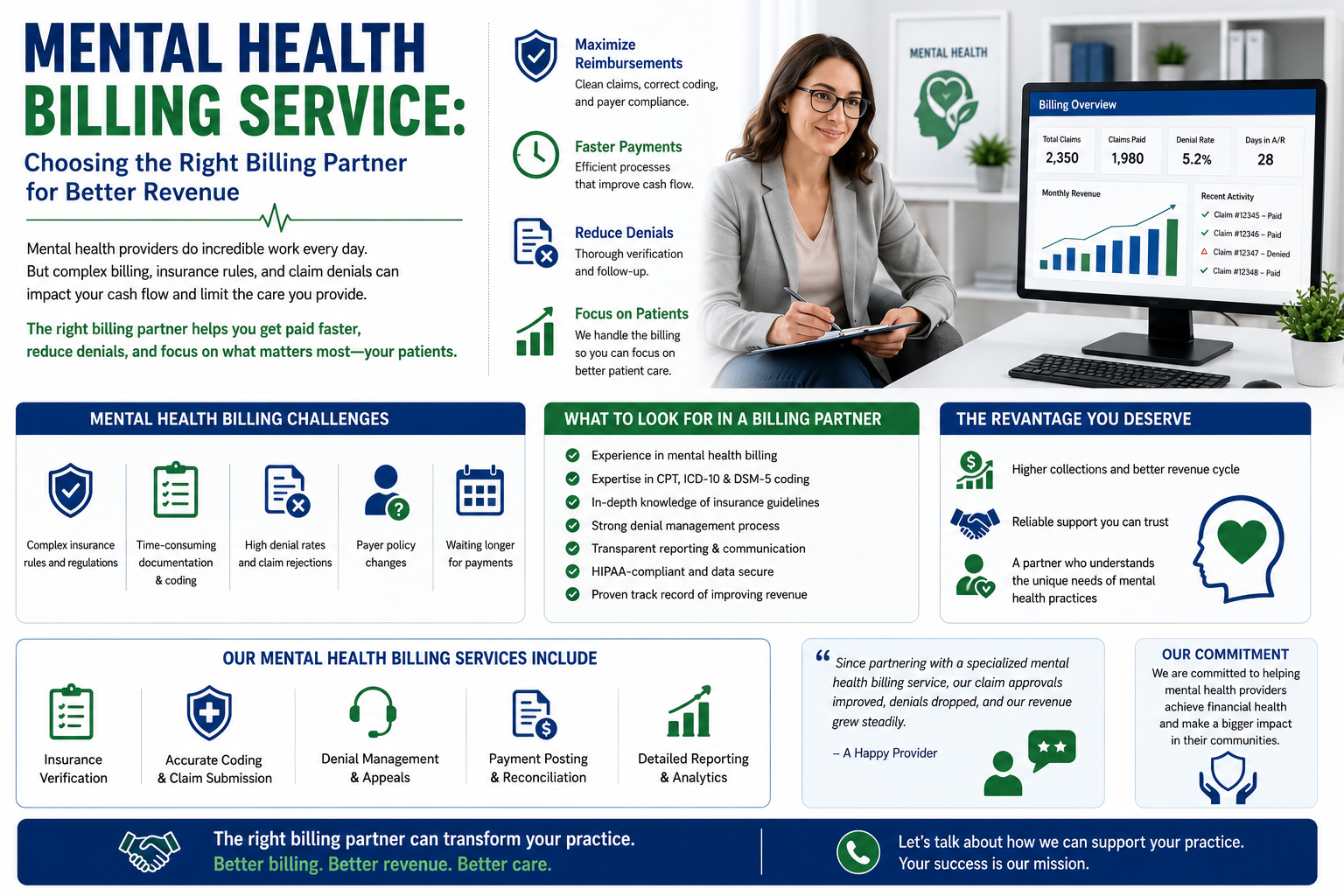
Mental health practices manage complex clinical and administrative responsibilities every day. While therapists, psychologists, psychiatrists, and other behavioral health professionals focus on patient care, billing teams must manage eligibility verification, claim submission, documentation requirements, payment posting, denials, and follow-up with insurance companies.
Because behavioral health billing involves specific payer requirements and sensitive patient information, choosing the right billing partner can have a direct impact on a practice’s financial operations. A reliable mental health billing service can help improve billing accuracy, reduce administrative pressure, and create a more organised revenue cycle.
However, not every billing company offers the same level of experience, technology, communication, or specialty knowledge. For this reason, practices should carefully evaluate their options before selecting a billing partner. Working with a qualified top medical billing company in USA can provide the expertise and operational support needed to manage the financial side of a mental health practice more efficiently.
What Is a Mental Health Billing Service?
A mental health billing service is a specialised revenue cycle solution designed to support behavioral health providers with the financial and administrative aspects of healthcare billing. These services may support psychiatrists, psychologists, licensed therapists, counselors, social workers, addiction treatment providers, and other mental health professionals.
The billing process often includes several connected steps, such as:
- Patient demographic and insurance information management
- Insurance eligibility and benefits verification
- Prior authorisation support when required
- Medical coding and charge entry
- Claim creation and electronic submission
- Claim status tracking
- Payment posting
- Denial management
- Accounts receivable follow-up
- Patient billing support
- Financial reporting
The goal is not simply to submit claims. A professional billing partner should help create a consistent process that supports accurate documentation, timely claim handling, and better visibility into the practice’s financial performance.
Why Mental Health Billing Requires Specialised Knowledge
Mental health billing is not always the same as billing for other medical specialties. Behavioral health practices may deal with therapy sessions, psychiatric evaluations, medication management, psychological testing, telehealth services, and other types of care.
Each service may have different documentation and payer requirements. In addition, insurance policies can vary based on the patient’s plan, provider network, service type, and authorisation requirements.
A specialised mental health billing service understands that billing accuracy depends on more than selecting a code. The billing process must connect the provider’s documentation, the service delivered, payer requirements, patient information, and claim submission rules.
This specialised knowledge can help identify common billing problems before they lead to unnecessary delays or rejections.
How the Right Billing Partner Can Support Better Revenue
Revenue improvement does not come from one isolated billing task. It usually depends on the performance of the complete revenue cycle.
A professional billing partner can support this process by helping practices maintain accurate patient information, verify coverage, submit cleaner claims, monitor unpaid balances, and follow up on unresolved accounts.
For example, when insurance information is not verified properly, a claim may be submitted to the wrong payer or under incorrect coverage details. When documentation and coding do not support the service billed, the claim may face additional review or denial.
A well-managed billing process helps reduce these avoidable issues. This is one reason many practices evaluate a top medical billing company in USA based on its ability to provide complete revenue cycle support rather than only basic claim submission.
Key Services to Look for in a Mental Health Billing Partner
Before selecting a billing company, mental health practices should understand which services are included in the partnership.
Eligibility and Benefits Verification
Insurance verification helps confirm whether a patient has active coverage and whether specific services may require additional authorisation or have plan limitations.
This process can help practices identify potential coverage issues before or during the patient’s care. Accurate verification also helps reduce avoidable claim problems related to inactive coverage or incorrect payer information.
Accurate Coding and Charge Entry
Correct coding is an important part of the billing process. A billing partner should have staff who understand the services commonly provided by behavioral health professionals and can review claims for potential coding and data-entry issues.
Coding should always be based on accurate provider documentation and applicable coding requirements. A qualified billing team should never encourage unsupported coding practices simply to increase reimbursement.
Claims Submission and Tracking
After a claim is prepared, the billing team should monitor its progress. Claim tracking can help identify rejected, pending, or unpaid claims that require additional attention.
A structured process allows the billing team to respond to issues instead of allowing claims to remain unresolved for extended periods.
Denial Management
Denials can occur for many reasons, including eligibility issues, missing information, coding problems, authorisation requirements, or payer-specific policies.
A strong mental health billing service should not only work on individual denied claims. It should also review denial patterns to identify recurring problems. If the same issue appears repeatedly, the practice may need to improve its front-end process, documentation workflow, or billing procedures.
Accounts Receivable Follow-Up
Outstanding insurance balances can affect a practice’s cash flow. Regular accounts receivable follow-up helps ensure that unpaid claims are reviewed and addressed.
A professional billing team may organise outstanding accounts based on factors such as claim status, payer response, balance, and age. This creates a more structured approach to follow-up.
What Makes a Top Medical Billing Company in USA a Good Choice?
The phrase top medical billing company in USA should not be judged only by company size or marketing claims. A strong billing partner should demonstrate practical expertise, transparent communication, reliable processes, and a clear understanding of the practice’s specialty.
When evaluating a billing company, consider the following factors.
Experience With Behavioral Health Billing
A company may have experience in general medical billing but limited knowledge of mental health services. Practices should ask whether the billing team has experience supporting their specific provider type and service model.
Relevant experience can help the billing team better understand the workflow and common challenges associated with behavioral health claims.
Knowledgeable Billing Staff
Billing staff should understand the importance of accurate documentation, coding, payer requirements, and claim follow-up.
A reliable company should also have processes for quality control and ongoing staff education. Healthcare billing requirements can change, so continuous learning is important for maintaining accurate workflows.
Clear Communication
Communication is an important part of any outsourced billing relationship. Practices should know who to contact when they have questions about claims, payments, denials, or reports.
The billing company should provide clear updates instead of leaving the practice uncertain about the status of important financial issues.
Transparent Reporting
A practice should be able to understand how its revenue cycle is performing. Regular reporting can provide information about submitted claims, payments, denials, outstanding accounts, and other important billing activities.
The best reporting approach depends on the practice, but information should be clear enough for the provider or practice manager to make informed decisions.
Data Security and Privacy Practices
Mental health practices handle highly sensitive patient information. Any billing partner that handles protected health information should have appropriate safeguards and follow applicable privacy and security requirements.
Before entering into a relationship, practices should review the company’s privacy, security, data handling, and compliance processes. A formal business associate agreement may also be required when applicable.
Questions to Ask Before Hiring a Mental Health Billing Service
Choosing a billing partner is an important business decision. Practices should ask practical questions before signing an agreement.
Consider asking:
- How much experience do you have with mental health billing?
- Which types of behavioral health providers do you support?
- What billing services are included?
- How are rejected and denied claims handled?
- How frequently is accounts receivable reviewed?
- What reports will the practice receive?
- Who will be the main point of contact?
- How is patient information protected?
- What technology or billing systems do you use?
- How are payer changes and billing updates handled?
The answers can help practices determine whether a company offers a genuine operational partnership or only a limited claims-processing service.
Common Mistakes to Avoid When Choosing a Billing Company
Some practices select a billing company based only on price. Although cost is an important consideration, the lowest price does not always represent the best overall value.
A company with limited specialty knowledge may create additional administrative work through errors, poor communication, or weak follow-up processes.
Another common mistake is failing to clarify the scope of services. Practices should understand exactly which activities are included in the agreement and which services may involve additional charges.
It is also important to avoid relying on unsupported promises. A professional billing company should explain its processes clearly and avoid guaranteeing financial results that depend on payer decisions, patient coverage, documentation, and other factors outside the billing company’s direct control.
In-House vs Outsourced Mental Health Billing
Mental health practices may choose to manage billing internally or outsource some or all billing functions.
An in-house team can provide direct control over daily operations, but the practice is responsible for hiring, training, managing, and retaining billing staff. The practice must also maintain billing technology and keep up with changes in payer requirements.
Outsourcing can provide access to specialised billing professionals without requiring the practice to manage every part of the billing operation internally.
The right choice depends on the practice’s size, staffing, workflow, budget, technology, and administrative needs. For many practices, the key question is not simply whether billing should be outsourced but whether the selected partner can provide reliable, specialty-focused support.
How Technology Supports Modern Mental Health Billing
Technology plays an important role in today’s healthcare revenue cycle. Electronic claims, billing software, electronic remittance information, automated eligibility tools, and reporting systems can help improve workflow efficiency.
However, technology alone does not guarantee better billing performance. The people managing the process must understand how to use the available tools correctly.
A strong mental health billing service combines technology with knowledgeable staff, quality control, effective communication, and consistent follow-up. This combination can help practices gain better visibility into their billing operations while reducing unnecessary manual work.
Why Experience and Trust Matter in Healthcare Billing
E-E-A-T principles are particularly important when evaluating healthcare-related information and service providers. Experience, expertise, authoritativeness, and trustworthiness help readers and practice owners assess whether a company is qualified to provide reliable information and services.
For a billing company, these signals may include:
- Demonstrated experience with healthcare billing
- Knowledge of behavioral health revenue cycle processes
- Clear and accurate communication
- Transparent service descriptions
- Strong privacy and security practices
- Professional client support
- Accurate and useful reporting
- A commitment to ethical billing practices
Practices should also evaluate the quality of the information a billing company publishes. Helpful content should explain billing concepts accurately, avoid misleading promises, and provide practical guidance that healthcare professionals can understand.
Final Thoughts
Selecting the right mental health billing service can help a practice create a more organised and reliable revenue cycle. From eligibility verification and claim submission to denial management and accounts receivable follow-up, each part of the billing process can influence financial performance.
When evaluating a top medical billing company in USA, mental health practices should look beyond general claims and focus on practical experience, specialty knowledge, communication, data security, reporting, and service transparency.
The right billing partner should function as an extension of the practice’s administrative team. By choosing a company with the right expertise and processes, mental health providers can spend less time managing billing challenges and more time focusing on the patients they serve.
