
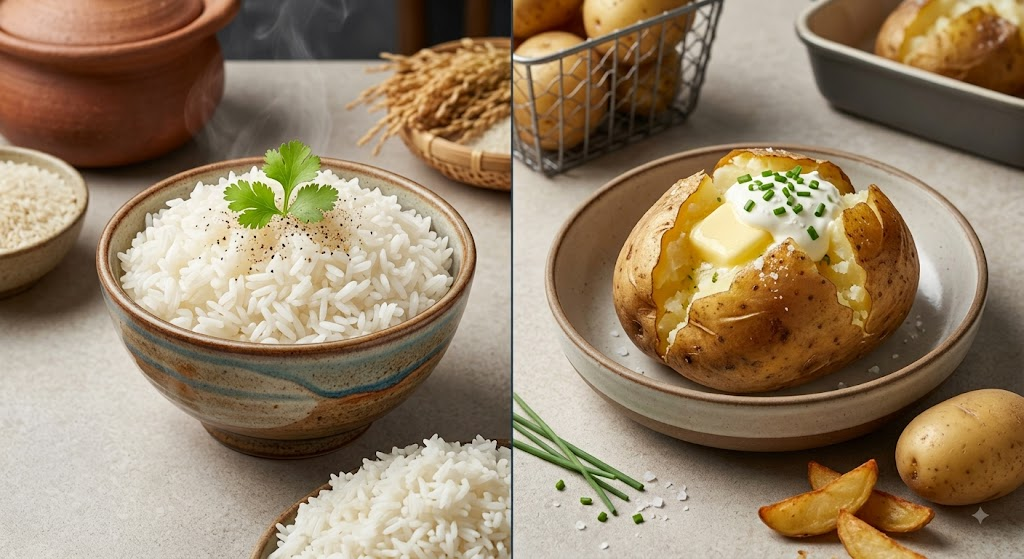
Ask a room full of people whether rice or potatoes are better for losing weight and you will get a confident answer either way. Potatoes got labelled fattening somewhere around the low-fat era and never fully recovered. Rice picked up a health halo it only partly earns. The numbers are less dramatic than either reputation suggests, and most of the confusion comes down to one thing people measure wrong.
The comparison everyone gets backwards
Per 100 grams cooked, white rice has 130 calories and a plain potato has 77. Rice carries 28.2g of carbohydrate to the potato’s 17.2g. Both are close to fat free, at 0.3g and 0.1g.
So the potato wins on calories by a wide margin, which surprises almost everyone. The catch is that nobody eats 100 grams of either.
This is where most home comparisons fall apart. People weigh rice dry, because that is how it comes out of the bag, and weigh potatoes whole, because that is how they come out of the ground. Dry rice is about 360 calories per 100g. It roughly triples in weight as it absorbs water, which is why the cooked figure lands at 130. Compare dry rice against a cooked potato and rice looks catastrophic. Compare them both cooked and the gap is real but ordinary.
Weigh both cooked, every time. If you want the full USDA breakdown side by side, the rice vs potato calories comparison lays out all six macros from FoodData Central entries 168880 and 170026.
Fiber is the bigger difference
Calories are the headline. Fiber is the part that changes how the meal actually feels.
A potato has 1.8g of fiber per 100g against rice at 0.4g. In practical portions that is 3.8g in a medium potato versus about 0.6g in a cup of white rice. That is a six-fold difference, and it shows up as fullness an hour later rather than as a number on a label.
Potatoes have a reputation for this. In satiety research they tend to score unusually well for a starchy food, which lines up with what people report anecdotally: a baked potato with a bit of protein holds you, a bowl of white rice often does not. Some of that is water content, some is fiber, some is simply that a potato takes longer to eat.
The potato also brings 926mg of potassium in a medium one. Rice brings none in any meaningful amount. If you are eating a lot of processed food, the potassium is not a trivial detail.
Where rice is the better choice
None of this makes rice a bad food, and the cases where it wins are specific enough to name.
Low fiber is a feature before training or during a stomach upset. Rice sits lightly and empties from the stomach quickly, which is exactly what you want an hour before a hard session and exactly what a potato is bad at.
Rice also portions cleanly. Half a cup cooked is 103 calories, and you can eyeball that after a week of practice. Potatoes vary enormously in size, and one medium potato covers a range wide enough to swallow a couple of hundred calories without you noticing.
And rice carries sauce in a way potatoes do not. A curry, a stir fry, a rice and beans plate: the grain exists to hold the flavourful thing. Swapping in potato changes the meal rather than the macros.
The cooled potato thing
Cooked and then cooled potatoes form resistant starch, which behaves more like fiber than like sugar in the gut. Potato salad and cold leftover potatoes have a lower glycemic response than the same potato hot.
This is real, and it is also smaller than the internet suggests. It is a reason to eat leftovers without guilt, not a weight loss strategy. Reheating partly reverses it.
What to do with this
If you are trying to eat fewer calories without eating less food, potatoes do that better. Same plate volume, roughly 40% fewer calories, considerably more fiber and potassium.
If you are trying to get calories in, or you are eating before training, or the meal is built around a sauce, rice does that better.
Most people would be well served by simply having both in rotation and weighing them cooked. The choice between these two matters far less than portion size and what you put on top. A potato loaded with butter and sour cream is not a lighter meal than plain rice, and a modest bowl of rice next to a large helping of vegetables and chicken is a perfectly reasonable dinner.
Track it for a fortnight, weigh things cooked, and the answer for your own eating will be obvious in a way no general article can be.
