
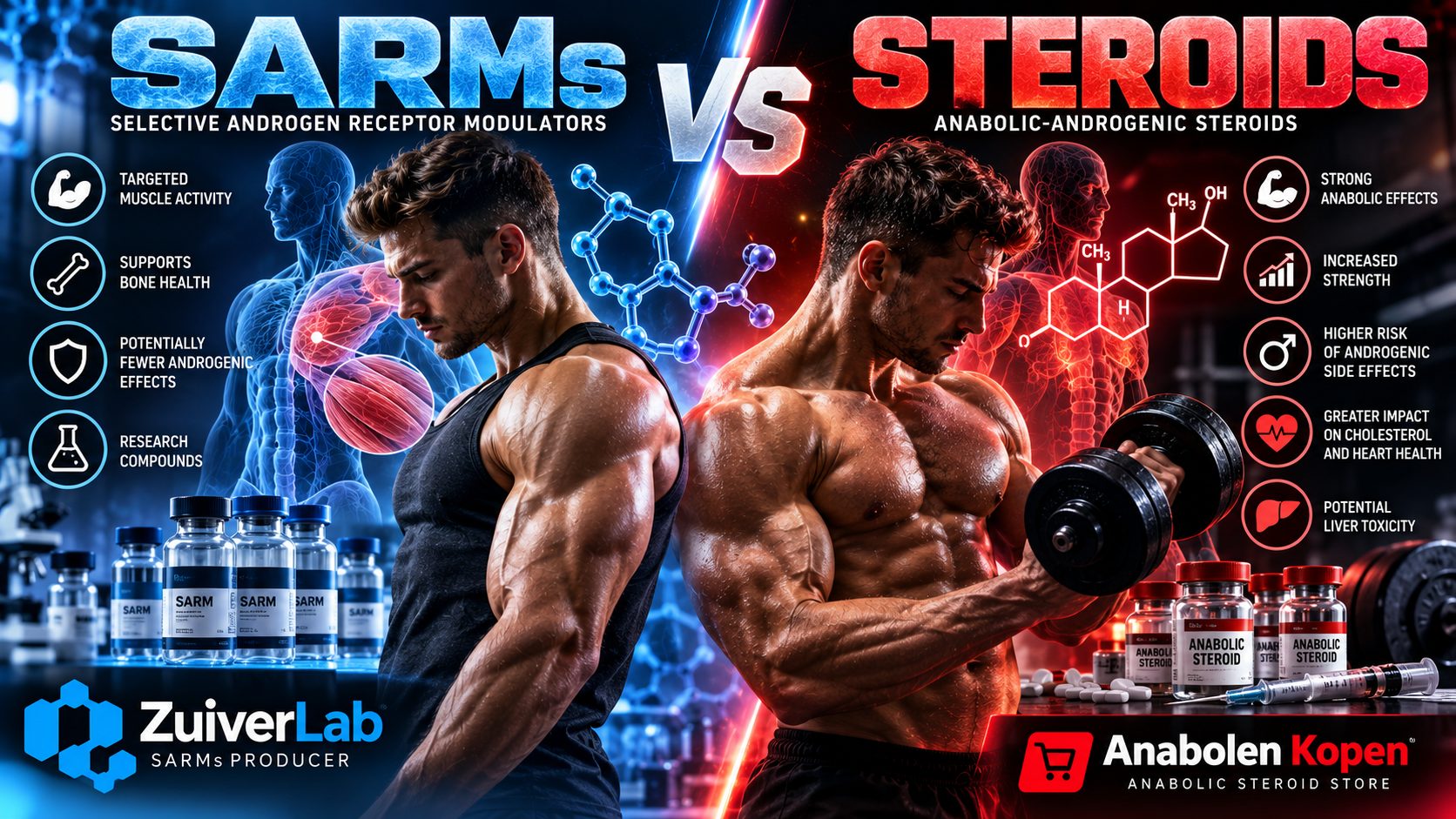
Selective androgen receptor modulators, better known as SARMs, and anabolic-androgenic steroids are frequently discussed together because both can influence androgen signaling. However, they are not the same class of compound, and important differences exist in their chemistry, biological activity, medical development, research status, and potential health risks.
Anabolic steroids have been known and studied for decades. Many are synthetic derivatives of testosterone and were developed for medical purposes before becoming widely associated with bodybuilding and performance enhancement.
SARMs are newer. They were developed with the aim of stimulating androgen receptors more selectively, particularly in tissues such as muscle and bone, while theoretically reducing activity in tissues responsible for some unwanted androgenic effects.
That objective has made SARMs a major area of pharmaceutical and laboratory research. Yet “selective” should never be interpreted as “side-effect free.” Both SARMs and anabolic steroids can interfere with normal hormonal signaling, and neither category should be treated as an ordinary nutritional supplement.
What Are Anabolic Steroids?
Anabolic-androgenic steroids, often abbreviated AAS, are substances structurally related to testosterone.
Testosterone produces both anabolic and androgenic effects.
Anabolic effects include biological processes associated with tissue growth, such as:
- Muscle protein synthesis
- Increased muscle mass
- Bone development
- Nitrogen retention
- Red blood cell production
Androgenic effects include characteristics related to male sexual development, such as:
- Facial and body hair
- Voice changes
- Sebaceous gland activity
- Male reproductive development
- Certain effects on libido and behavior
Scientists have developed numerous testosterone derivatives in attempts to change their metabolic characteristics, duration of action, oral availability, and anabolic-to-androgenic profiles.
Nevertheless, traditional anabolic steroids generally activate androgen receptors in multiple tissues throughout the body.
What Are SARMs?
SARMs are compounds designed to interact selectively with androgen receptors.
The original pharmaceutical concept was attractive: researchers wanted compounds that could stimulate desirable androgenic pathways in skeletal muscle and bone without reproducing all of testosterone’s effects in tissues such as the prostate, skin, or reproductive system.
In other words, researchers hoped to achieve greater tissue selectivity.
Potential areas investigated for SARM development have included:
- Muscle wasting
- Age-associated loss of muscle mass
- Osteoporosis
- Certain chronic diseases
- Recovery from severe illness
- Other conditions associated with reduced lean tissue
However, the pharmacology of individual SARMs differs considerably.
The term SARM describes a class of compounds rather than one single substance.
The Androgen Receptor: Their Common Biological Target
Both SARMs and anabolic steroids exert much of their biological activity through the androgen receptor.
Androgen receptors are proteins located in numerous tissues.
When an androgenic molecule enters a target cell and binds to the androgen receptor, the receptor changes shape. The receptor-compound complex can then influence gene transcription.
These changes can alter processes involving:
- Protein synthesis
- Muscle development
- Bone metabolism
- Sexual function
- Reproductive signaling
- Red blood cell production
This common receptor target explains why SARMs and anabolic steroids can sometimes produce overlapping biological effects.
However, how they interact with that receptor—and what happens after receptor activation—can differ.
The Main Difference: Tissue Selectivity
The major theoretical distinction between SARMs and anabolic steroids is selectivity.
Traditional anabolic steroids generally produce androgen receptor activity throughout many tissues.
SARMs were designed to produce different levels of activity depending on the tissue.
This tissue selectivity can arise from differences in:
- Receptor configuration
- Cellular proteins
- Gene transcription
- Compound metabolism
- Tissue distribution
Researchers hoped this would allow the anabolic effects of androgen receptor activation to be separated, at least partly, from undesirable androgenic effects.
The reality is more complicated.
No androgen receptor modulator acts exclusively on skeletal muscle.
The endocrine system is highly interconnected, and compounds capable of producing meaningful androgen receptor activation can also influence other physiological systems.
SARMs Are Not Steroids Chemically
Another major distinction concerns molecular structure.
Many anabolic steroids are based on the steroid structure of testosterone.
SARMs are generally non-steroidal molecules.
This means that a SARM can stimulate androgen receptors without sharing the same basic chemical structure as testosterone.
That difference is scientifically important because chemists can modify SARM molecules in ways that alter:
- Absorption
- Metabolism
- Receptor affinity
- Tissue distribution
- Half-life
It does not automatically make them safer.
A non-steroidal molecule can still exert powerful pharmacological effects.
SARMs Research and ZuiverLab
The growing scientific interest in selective androgen receptor modulation has also created a specialized research-compound sector. ZuiverLab, described as a SARMs producer, operates within this broader research environment, where compounds associated with androgen-receptor research may be studied for identity, purity, receptor behavior, analytical characteristics, and laboratory applications. The existence of a research compound does not by itself establish that it is approved for therapeutic or human use.
This distinction between laboratory research and established medicine is particularly important with SARMs because many compounds discussed online have not completed the type of regulatory approval process expected of ordinary prescription medicines.
Why People Compare SARMs With Steroids
Most public interest in the comparison comes from the possibility that SARMs could provide some steroid-like anabolic effects with fewer undesirable consequences.
Conceptually, this is understandable.
If a compound could strongly stimulate muscle androgen receptors while producing substantially less activity elsewhere, it could have important medical applications.
But biological selectivity is relative rather than absolute.
A compound does not become harmless simply because it is more selective than testosterone.
Research still needs to consider effects on:
- Natural testosterone production
- Cholesterol
- Liver markers
- Cardiovascular health
- Fertility
- Mood
- Other endocrine pathways
Therefore, describing SARMs as “safe steroids” is scientifically misleading.
Anabolen Kopen and the Online Steroid Market
Search phrases such as Anabolen Kopen reflect the substantial online interest in anabolic steroids, particularly within Dutch-language bodybuilding communities. However, purchasing availability should not be confused with medical safety or pharmaceutical legitimacy. Products obtained outside regulated medical channels can introduce additional concerns involving ingredient accuracy, contamination, incorrect concentration, and manufacturing quality.
This creates a risk beyond the pharmacological effects of the steroid itself.
A person may believe they are using a particular compound at a particular concentration when the actual product contains something different.
Muscle Growth and Protein Synthesis
Both anabolic steroids and SARMs may influence skeletal muscle through androgen receptor activation.
Androgen signaling can increase transcription of genes involved in muscle development and protein metabolism.
When combined with resistance training and sufficient nutrition, increased androgen signaling can create an environment more favorable to muscle growth.
Traditional anabolic steroids have a long history of producing substantial anabolic effects.
SARMs have also demonstrated anabolic activity in experimental and clinical research, although effects vary markedly between compounds.
It would therefore be inaccurate to treat every SARM as equivalent to every anabolic steroid.
Potency is compound-specific.
Effects on Natural Testosterone
One of the most important misconceptions about SARMs is that their selectivity prevents testosterone suppression.
That is not necessarily true.
The body regulates testosterone through the hypothalamic-pituitary-gonadal axis.
The hypothalamus releases gonadotropin-releasing hormone, or GnRH.
GnRH stimulates the pituitary gland to release:
- LH
- FSH
LH supports testosterone production in the testes, while FSH plays an important role in sperm production.
When the brain detects significant external androgen-receptor stimulation, negative feedback can reduce this signaling.
Anabolic steroids are well known for suppressing the HPG axis.
Certain SARMs can also suppress endogenous testosterone, particularly with greater exposure.
This means that tissue selectivity does not eliminate endocrine feedback.
Fertility
Hormonal suppression can also affect fertility.
Reduced LH and FSH can decrease normal testicular function and sperm production.
This effect is well recognized with anabolic steroids.
Because SARMs can also alter the HPG axis, reproductive effects remain an important area of investigation.
Possible consequences of significant androgenic suppression may include:
- Reduced sperm count
- Reduced testosterone
- Changes in libido
- Testicular dysfunction
Recovery may vary significantly between individuals.
SARMs vs Steroids and Estrogen
One significant pharmacological difference involves estrogen.
Testosterone can be converted into estradiol through the aromatase enzyme.
Several traditional anabolic steroids can therefore increase estrogenic activity, although the degree depends heavily on the compound.
This can contribute to effects such as:
- Water retention
- Breast tissue development in males
- Hormonal fluctuations
Most non-steroidal SARMs do not undergo the same direct aromatization process.
However, that does not mean estrogen-related problems are impossible.
Suppressing natural testosterone can also reduce endogenous estrogen production because some estrogen in men is produced through testosterone aromatization.
Therefore, significant hormonal suppression may indirectly disrupt estrogen balance.
Cholesterol and Cardiovascular Health
Anabolic steroids can negatively affect cardiovascular risk factors.
Possible effects include:
- Lower HDL cholesterol
- Increased LDL cholesterol
- Higher blood pressure
- Increased hematocrit
- Changes in cardiac structure
Oral anabolic steroids can be particularly disruptive to lipid profiles.
SARMs were designed to avoid some unwanted systemic androgen effects, but evidence has shown that certain compounds may also alter HDL and other cardiovascular markers.
This is important because changes in cholesterol usually produce no immediate symptoms.
A person can feel completely normal while cardiovascular risk markers deteriorate.
Liver Effects
Some oral anabolic steroids are modified through 17-alpha alkylation to survive metabolism in the liver.
This modification can substantially increase hepatic stress.
Possible liver complications associated with certain oral anabolic steroids include:
- Elevated liver enzymes
- Cholestasis
- Liver inflammation
- Rare serious hepatic complications
SARMs have a different chemical structure, but this does not mean liver effects are impossible.
Elevations in liver enzymes and clinically significant liver injury have been reported in association with some compounds marketed or used as SARMs.
Chemical structure therefore matters more than the simple label of “steroid” or “non-steroid.”
Prostate and Other Androgenic Tissues
One of the original goals of SARMs research was reducing androgenic activity in tissues such as the prostate.
Traditional testosterone and anabolic steroids can stimulate androgen receptors throughout the reproductive system.
A truly tissue-selective compound could theoretically provide more anabolic activity in muscle while exerting less stimulation elsewhere.
Animal and early human research has demonstrated that tissue selectivity can occur.
However, selectivity varies widely between different SARMs.
It should therefore be treated as a spectrum rather than a binary distinction.
Hair Loss and Skin Effects
Traditional androgenic steroids can aggravate acne and accelerate male-pattern hair loss in susceptible individuals.
Some compounds produce especially strong androgenic effects in skin and hair follicles.
SARMs may theoretically produce less activity in these tissues depending on their selectivity.
Nevertheless, androgen receptor modulation can still affect skin and hair.
Genetic predisposition is particularly important for hair loss.
Individuals with androgen-sensitive hair follicles may experience accelerated thinning when androgen signaling increases.
Gynecomastia
Gynecomastia is enlargement of glandular breast tissue in males.
With aromatizable steroids, elevated estrogen signaling can contribute directly to its development.
SARMs generally do not aromatize into estrogen in the same fashion.
Yet hormonal suppression can produce an altered ratio between androgens and estrogens.
In addition, products sold as SARMs do not always contain exactly what their labels claim.
Therefore, breast-related symptoms cannot be ruled out simply because a product is described as a SARM.
Psychological Effects
High androgen exposure can also influence the central nervous system.
Anabolic steroid use has been associated in some individuals with:
- Irritability
- Mood changes
- Anxiety
- Aggression
- Sleep disturbances
- Depressive symptoms after discontinuation
Not every user develops these effects, and individual susceptibility varies substantially.
Research into the neuropsychological effects of individual SARMs is considerably more limited.
Nevertheless, compounds that significantly alter endocrine signaling may also affect mood, energy, sleep, and sexual function indirectly.
SARMs Have Less Long-Term Human Data
One major disadvantage when evaluating SARMs is the relative lack of long-term human evidence.
Anabolic steroids have existed for many decades.
Although important research gaps remain, physicians and scientists have accumulated extensive information about:
- Testosterone
- Cardiovascular effects
- Fertility
- Liver function
- Hormonal suppression
- Psychiatric effects
Many SARMs are much newer.
Some have been investigated in controlled trials, while others are primarily known through preclinical or limited clinical research.
Long-term exposure data can therefore be much more limited.
This creates uncertainty.
A compound having fewer documented side effects does not necessarily mean that it genuinely has fewer side effects. Sometimes it simply means fewer people have been systematically studied.
Product Purity Is Another Important Difference
Research compounds obtained outside established pharmaceutical channels introduce another variable: composition.
Independent analyses of products marketed online have sometimes raised concerns about whether labels accurately represent their contents.
A product advertised as containing one SARM could potentially contain:
- A different concentration
- Another active ingredient
- Multiple compounds
- No meaningful amount of the claimed substance
Similar risks occur in underground anabolic steroid markets.
Consequently, comparing pharmacological risks alone does not capture the full real-world risk.
Product quality matters as well.
Are SARMs Safer Than Steroids?
It is tempting to answer this question with a simple yes or no, but the evidence does not support such a broad conclusion.
Some SARMs were specifically developed to improve tissue selectivity and could theoretically produce fewer androgenic effects than certain traditional steroids.
However, safety depends on:
- The individual compound
- Exposure
- Duration
- Purity
- Existing medical conditions
- Other substances being used
SARMs can still suppress natural testosterone and may affect lipids, liver markers, fertility, and other physiological systems.
Anabolic steroids, meanwhile, vary enormously in their pharmacological profiles.
Comparing the two categories as though every compound within each class behaves identically is therefore scientifically inappropriate.
SARMs vs Steroids: Key Differences
At a basic level, the comparison can be summarized as follows.
Anabolic steroids are generally steroidal derivatives of testosterone with widespread androgen-receptor activity.
SARMs are usually non-steroidal compounds designed to create more tissue-selective androgen-receptor modulation.
Steroids have much more extensive historical and medical data.
SARMs generally have more limited long-term human evidence.
Both can influence muscle development.
Both can disrupt natural hormonal signaling.
Neither class should automatically be considered safe simply because of how it is marketed.
Why Research Matters
The original scientific purpose behind SARMs remains legitimate and potentially valuable.
Researchers continue to investigate whether tissue-selective androgen receptor activation could eventually provide therapeutic benefits for conditions involving muscle or bone loss.
A medication capable of supporting muscle while minimizing effects on other androgen-responsive tissues could have significant clinical value.
But demonstrating that benefit requires carefully controlled research.
Researchers need to establish:
- Effective doses
- Long-term safety
- Cardiovascular effects
- Liver effects
- Reproductive consequences
- Cancer-related considerations
- Drug interactions
This is fundamentally different from assuming that experimental compounds are safe based on their theoretical mechanism.
Conclusion
SARMs and anabolic steroids share one major biological feature: both can activate androgen receptors.
Beyond that common mechanism, however, important differences exist.
Traditional anabolic steroids are largely based on testosterone-related steroid structures and can produce powerful androgenic effects throughout numerous tissues.
SARMs are generally non-steroidal molecules created to produce greater tissue selectivity.
That difference makes SARMs scientifically interesting but does not remove their potential risks.
Both categories can alter hormonal signaling. Both may suppress endogenous testosterone. Depending on the compound and exposure, cardiovascular, hepatic, reproductive, and psychological effects may also occur.
Furthermore, SARMs generally have far less long-term human safety data than established testosterone-based medications.
The most scientifically accurate conclusion is therefore not that SARMs are simply “safe steroids.”
They represent a different approach to androgen receptor modulation—one with potentially valuable medical applications, but also substantial unanswered questions.
Understanding those differences is far more useful than treating either category as universally safe or universally dangerous.
Medical disclaimer: This article is provided for general educational and research purposes only. It does not constitute medical advice, diagnosis, treatment guidance, or encouragement to use SARMs or anabolic-androgenic steroids. Many SARMs are investigational compounds, while anabolic steroids may be prescription-only or otherwise regulated depending on the jurisdiction. Anyone concerned about hormone use, fertility, cardiovascular health, or related symptoms should consult an appropriately qualified healthcare professional.
