
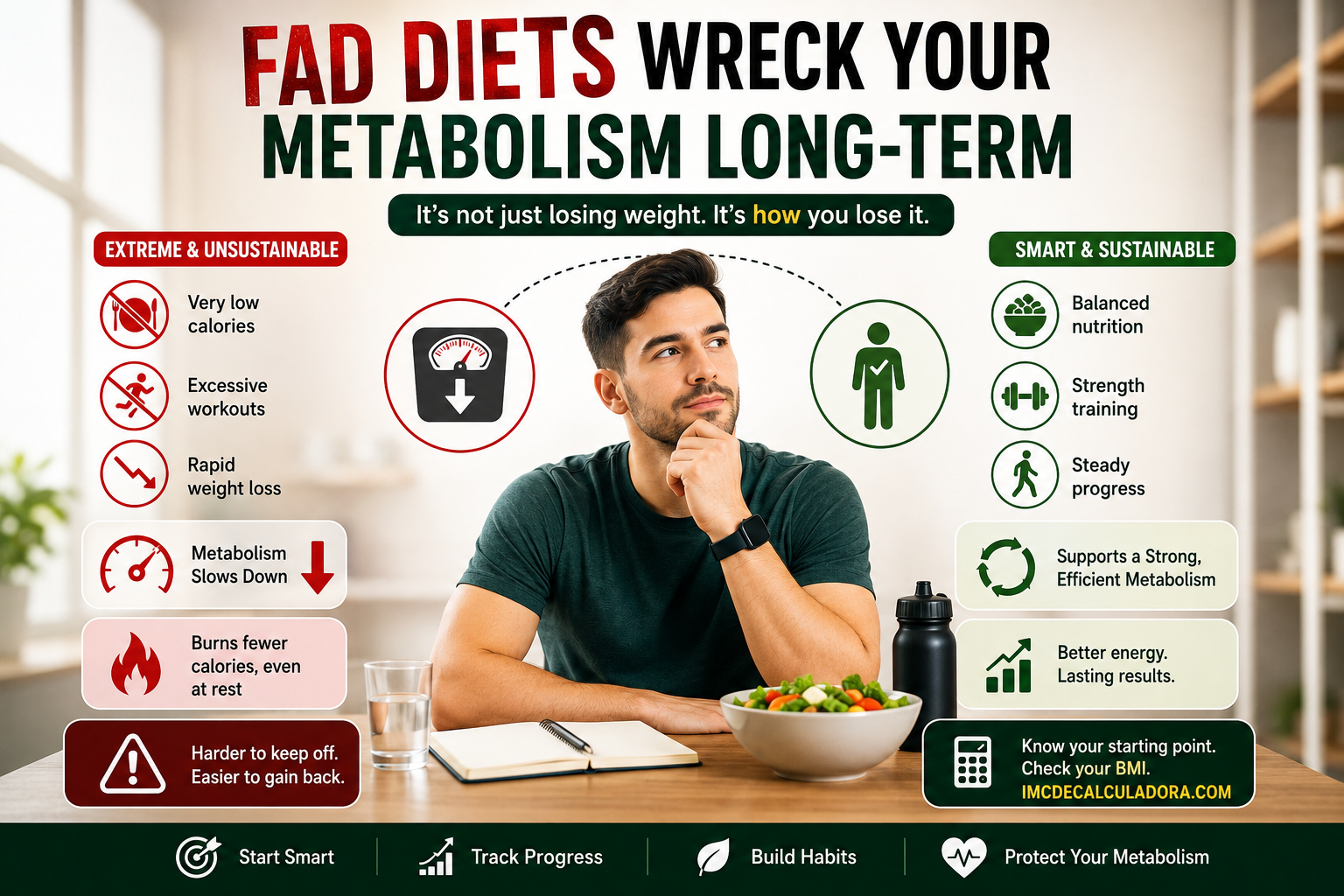
Most articles on this topic tell you the same three things: crash diets are bad, your metabolism “slows down,” and you should eat more protein. None of that is wrong exactly, but it skips the part that actually matters, and the part that recent research has gotten strikingly wrong for years.
The real story isn’t that restrictive dieting breaks your metabolism forever. It’s that how you lose the weight, and what you do while you’re losing it, determines whether the damage is temporary or sticks around for the better part of a decade. And the evidence for this comes from one of the most closely studied, and most misunderstood, groups of dieters on record: the contestants of The Biggest Loser.
What actually happened to their metabolisms
In 2016, researchers led by Kevin Hall at the National Institutes of Health tracked down 14 of the show’s original contestants six years after they’d competed. The findings were startling. During the 30-week competition, contestants lost an average of 58 kg and their resting metabolic rate (RMR), the energy the body burns just to stay alive, dropped by roughly 610 calories a day, far more than their smaller body size alone would predict. It’s a useful reminder that a single number like weight, or even the IMC de calculadora most people check once and forget about, only tells part of the story, the metabolic engine underneath can be shifting long before it shows up on a scale.
That drop was expected. What wasn’t expected was that six years later, after most contestants had regained an average of 41 kg, their metabolic rates hadn’t recovered. If anything, they’d fallen further, landing about 704 calories a day below where they’d started. One well-documented case involved a contestant whose weight had crept most of the way back up after several years, and who found he could only hold that new, heavier weight steady on a daily intake close to what a small child would eat.
For years, this was cited as proof that extreme dieting permanently “breaks” your metabolism. That explanation turned out to be incomplete.
The overlooked variable: it wasn’t just the diet
In 2021, Hall published a reinterpretation of his own data, and this is the part almost nobody covers when they write about this topic. He found that contestants who increased their physical activity the most in the years after the show, some by 80% or more compared to baseline, were also the ones whose metabolic rates had slowed the most.
That’s counterintuitive on its face. More exercise should mean more calories burned, not fewer. But it lines up with a separate line of research on hunter-gatherer populations, which found that people with very high activity levels don’t necessarily burn more total calories than sedentary people, their bodies simply dial back energy spent on other processes to keep total output roughly constant. Hall’s read on his own contestants was that the sustained, intense exercise they kept up for years may have triggered compensatory adaptations that suppressed resting metabolism, as the body tried to keep total energy expenditure within a narrow, defended range regardless of how much was being burned through movement.
In other words, the villain wasn’t simply eating too little for 30 weeks. It was the combination of an extreme calorie deficit and an extreme, unsustainable spike in activity, both pushing the body toward the same defensive response.
The hormonal mechanics behind the slowdown
The biological machinery behind this is fairly well mapped out, even if the full picture is still being filled in. When you cut calories hard, fat cells produce less leptin, the hormone that signals to your hypothalamus that energy stores are adequate. As leptin falls, the brain responds by dialing down sympathetic nervous system activity, which lowers thyroid hormone output and reduces the resting energy your body spends on basic maintenance. Ghrelin, the hormone that drives hunger, rises at the same time, which is part of why appetite becomes so much harder to manage the longer a restrictive diet continues.
This isn’t a malfunction. It’s a survival response that evolved for famine, not for a 1,200-calorie diet chosen voluntarily to fit into a specific outfit by a specific date. The body doesn’t know the difference between the two.
Separately from resting metabolism, there’s a decline in what researchers call non-exercise activity thermogenesis, or NEAT, the countless small movements like fidgeting, taking the stairs, or standing rather than sitting that burn calories without registering as “exercise.” Under sustained calorie restriction, NEAT drops, often without the person noticing they’ve become less fidgety or restless. It’s one more way the body claws back energy it thinks it can’t spare.
Where the popular narrative gets ahead of the evidence
Here’s the twist that most fad-diet content won’t tell you, because it complicates a tidy warning story: not all of the fear around “yo-yo dieting” itself holds up under scrutiny.
For decades, the assumption was that repeated cycles of losing and regaining weight, separate from any single extreme diet, cause their own cumulative damage: extra fat gain, muscle loss, and a progressively slower metabolism with each cycle. A systematic review published in Current Obesity Reports in 2024 that pooled 23 human studies found no consistent evidence that weight cycling itself causes disproportionate loss of lean muscle mass or a lasting metabolic slowdown, once you look past the confounding effects of the original diet.
A more recent analysis, published in The Lancet Diabetes & Endocrinology in 2026, went further. After re-examining decades of observational studies, clinical trials, and animal research, the authors concluded that once you properly account for pre-existing health conditions, aging, and cumulative time spent at a higher weight, most of the supposed harms of weight cycling largely disappear. Weight regain does undo the health benefits gained during weight loss, blood sugar, blood pressure, and cholesterol improvements tend to reverse, but that’s not the same as ending up worse off than if the diet had never happened at all.
So the honest, more complicated version of the story is this: it’s not that losing and regaining weight is inherently corrosive. It’s specifically severe, rapid, extreme interventions, very low-calorie diets, aggressive exercise spikes layered on top of aggressive restriction, or both sustained for months, that appear to trigger the kind of persistent metabolic adaptation seen in the Biggest Loser cohort. A moderate diet that’s regained and tried again doesn’t carry the same signature in the data.
What this actually means if you’re trying to lose weight
The practical takeaway isn’t “don’t bother dieting” or “your metabolism is fine no matter what you do.” It’s narrower and more useful than that: the danger zone is extreme, fast weight loss achieved through severe calorie deficits, especially when paired with a sudden, dramatic jump in exercise volume that isn’t sustainable past the initial push.
A slower approach, a moderate deficit, resistance training to preserve muscle mass, and periodic diet breaks at maintenance calories to let leptin and thyroid output partially recover, appears to blunt the adaptive response considerably compared to the crash-diet-plus-bootcamp model that dominates most transformation stories.
Tracking your numbers over time, rather than chasing a single dramatic before-and-after, is a reasonable way to catch a stalling metabolism early rather than six years too late. A simple starting point is knowing where your weight trend actually sits relative to a healthy range, and comparing it against a standard Tabla IMC before deciding how aggressive a plan you actually need, the slower, steadier route almost always turns out to be the one your metabolism can actually keep up with.
Conclusion
Fad diets don’t fail people because willpower runs out, and they don’t leave permanent scars simply because the weight came back. What actually seems to do lasting damage is the specific combination of severe restriction and an unsustainable spike in activity, held for months at a time, the exact pattern that reality-TV weight loss and most crash diets are built around. Strip that combination out, and the body’s ability to bounce back looks far more resilient than the popular “your metabolism is broken forever” narrative suggests.
That’s actually the more empowering version of the story. It means the goal isn’t to fear dieting altogether or to treat every regained pound as proof of permanent damage, it’s to be specific about what kind of weight loss you attempt. A pace your body doesn’t experience as a crisis is a pace it won’t spend the next several years quietly working to undo.
