
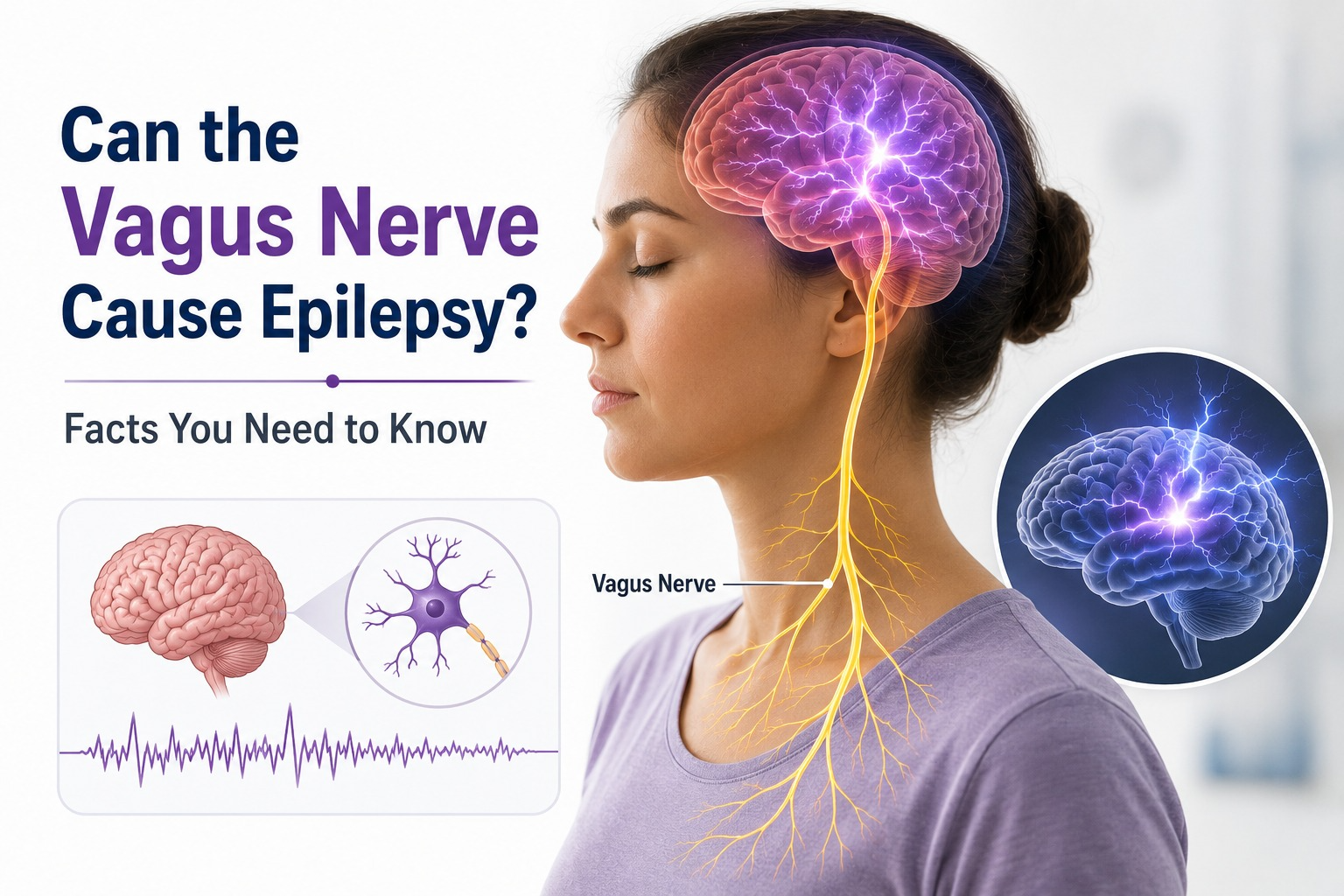
In recent years, the vagus nerve has gained much interest in health discussions, especially regarding its role in stress, digestion, heart rate, and now even more related to brain health and seizures. In this regard, patients suffering from epilepsy might wonder about the involvement of this nerve in their condition. However, it is important to clarify that the vagus nerve does not exist as a cause of epilepsy, but rather a valuable tool for its treatment nowadays, especially among patients who do not respond to medication therapy.
Key Takeaways
| The vagus nerve does not cause epilepsy. Seizures originate from abnormal electrical activity in the brain, not from the vagus nerve itself.Vagus nerve stimulation is an established, evidence-based treatment for medication-resistant epilepsy that reduces seizure frequency in a meaningful proportion of patients.The mechanism by which VNS reduces seizures is still not fully understood, but it involves broad modulation of brain electrical activity through ascending nerve pathways.Medication remains the first-line treatment for epilepsy, and VNS is used alongside rather than instead of antiseizure medications in most patients. |
What the Vagus Nerve Is and What It Does
The vagus nerve can be described as the longest cranial nerve in the human body. This nerve stretches from the brainstem down the neck, through the chest, and into the abdomen. This nerve is a part of the autonomic nervous system. The vagus nerve contains both sensory and motor fibres, meaning it is responsible for controlling functions like heart rate management, respiration, and digestion as well as transferring information from one part of the body to another.
Most of the fibres in the vagus nerve are afferent fibres that transmit signals upward from the organs to the brain instead of from the brain to the organs.
Does the Vagus Nerve Cause Epilepsy
It does not cause seizures. Epilepsy stems from atypical, unrestrained, or simultaneous discharges of impulses in brain cortex cells. The vagus nerve cannot directly cause epilepsy and, therefore, cannot have any role in any type of epilepsy. Seizures occur from different processes happening in the brain.
When it comes to epilepsy, its connection with the vagus nerve appears in the form of therapeutic usage of electrical stimulation applied to the vagus nerve, called vagus nerve stimulation, because it uses pathways of nerves connected in the brain regions responsible for seizure generation and conduction.
What Vagus Nerve Stimulation Is and How It Works
Vagus nerve stimulation is a procedure in which a pulse generator is implanted beneath the skin; a wire connecting this generator leads to a coil surrounding the left vagus nerve in the neck. This device sends electrical impulses through the vagus nerve at certain intervals, typically every five minutes, throughout the day and night.
The choice of the left over the right vagus nerve is due to the higher risk of cardiac side effects from stimulating the right vagus nerve. While it is not fully understood how vagus nerve stimulation can achieve seizure control, the currently accepted principles indicate that stimulation impulses through the left vagus nerve lead to stimulation of ascending vagal fibres to the nucleus tractus solitarius in the brainstem, which then activates the thalamus, locus coeruleus, and cortex. Until this point, knowledge of these interactions continues to contribute to the modulation of brain electrical activity in order to minimise the chances and severity of the seizure.
Who Benefits From Vagus Nerve Stimulation
VNS is a therapy that can be used for people who have intractable epilepsy, which is described as the failure of two or more suitable anti-seizure medications to achieve prolonged seizure freedom. It may be used in individuals from four years of age and above, regardless of the seizure type or epilepsy syndrome.
Long-term follow-up trials and studies show that almost half of the patients get at least a 50% reduction in seizure frequency with VNS over the years, and patients’ outcomes seem to increase over time.
Understanding Seizure Types and the Broader Clinical Picture
Understanding seizure disorders is necessary when learning about the role of vagus nerve stimulation in the management of such medical issues. Different seizure types respond differently to vagus nerve stimulation. Generalised epilepsy, such as Lennox-Gastaut syndrome, and some of the focal seizure types have shown some promising results with vagus nerve stimulation. For those patients who have easily defined seizure foci and do not have the contraindications for surgery, surgery will be offered first.
The Specialist Role in Guiding These Decisions
All decisions regarding VNS candidacy belong firmly within Neurology, specifically within epilepsy specialist practice. A comprehensive pre-surgical evaluation that includes prolonged video-EEG monitoring, high-resolution MRI, neuropsychological assessment, and in some cases functional imaging determines whether surgery or neuromodulation is the more appropriate non-pharmacological option for each patient.
When Medication Remains the Primary Approach
Antiseizure medication is the best and non-invasive way to treat patients who have epilepsy and for whom treatment has worked. Pregabalin is known for its ability to treat epilepsy because of its properties related to the α2δ subunit of voltage-gated calcium channels. It decreases neurotransmission by binding to these channels and affecting neuronal excitability.
Maxgalin ER 100 is an extended-release formulation of Pregabalin, which means it provides a more consistent medication level and might lead to fewer side effects.
Managing Side Effects of VNS and Medication
The effects associated with VNS are usually restricted to the time when stimulation is being applied, as they may include voice changes or hoarseness, feelings of discomfort in the throat while being stimulated, a cough or tingling in the area of the neck during the application of the stimulation. These effects are quite tolerable and can gradually reduce in their intensity after the course of treatment. Cardiac monitoring is carried out during the implantation and the first programming of the device.
Pregabalin can lead to dizziness, sedation and peripheral oedema, especially during the first weeks of treatment or after an increase in the dose. The titration of the dose is done slowly and minimises the side effects mentioned previously.
Importance of Follow-Up Care
VNS requires regular device programming reviews, typically every three to six months in the first year and then annually once optimal settings are established. Antiseizure medication doses are reviewed alongside device settings, as some patients achieve sufficient seizure reduction to allow gradual medication reduction over time. Seizure diary documentation between appointments supports accurate assessment of treatment response.
What Is Worth Remembering
Epilepsy is not caused by the vagus nerve, but it is increasingly being used as a means of treating epilepsy. In cases where seizures cannot be sufficiently controlled with medicine, managing epilepsy via vagus nerve stimulation provides a non-medication treatment option that is able to help many people achieve significant reductions in the levels of seizure activity. To decide on vagus nerve stimulation, one should go through the specialised epilepsy evaluation process, and the patient should be provided with all necessary information about the right expectations.
