
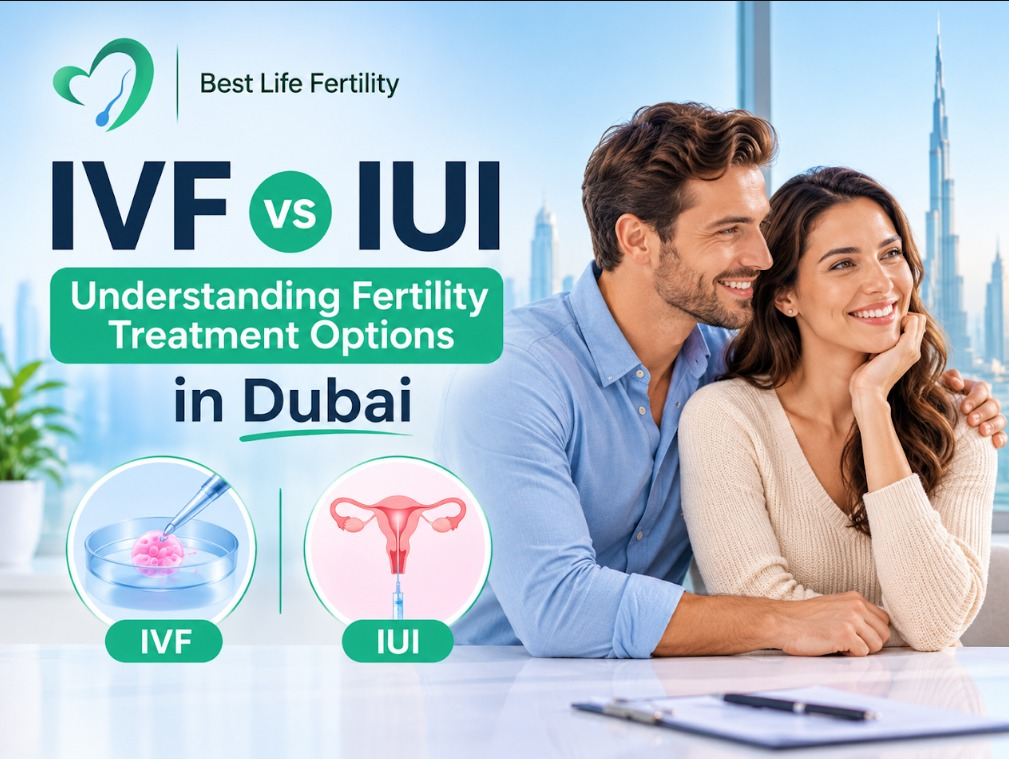
For couples trying to conceive, choosing a fertility treatment can sometimes be difficult. There are several options available, and the right one can depend on the reason for infertility and the couple’s individual circumstances. Two treatments that are often discussed are IUI (intrauterine insemination) and IVF (in vitro fertilisation).
Although both treatments are used to help with conception, they work in different ways. Understanding these differences can help patients have a clearer discussion with a fertility specialist and know what to expect from each approach.
What is IUI?
IUI is a fertility treatment in which prepared sperm is placed directly into the uterus around the time of ovulation. Before the procedure, the sperm sample is processed in the laboratory to concentrate suitable sperm. Depending on the patient’s situation, IUI may be carried out during a natural cycle or with medication to stimulate ovulation.
One of the main differences between IUI and IVF is where fertilisation takes place. With IUI, fertilisation still occurs naturally inside the reproductive tract. The procedure simply places the sperm closer to where it needs to be at the right time. IUI is generally less invasive than IVF and involves fewer stages.
It may be considered in some cases of unexplained infertility, mild male-factor infertility or when donor sperm is being used. For patients considering IUI treatment in Dubai, the fertility specialist will assess factors such as ovulation, the fallopian tubes and sperm quality before recommending treatment. However, IUI is not suitable for every patient.
What is IVF?
IVF involves fertilising an egg with sperm in a laboratory and then transferring the resulting embryo into the uterus. An IVF cycle usually starts with medication to stimulate the ovaries so that several follicles can develop. The patient is monitored during this stage, usually with ultrasound scans and, when needed, blood tests.
Once the eggs are ready, they are collected and taken to the laboratory. The eggs are then fertilised with sperm, and the developing embryos are monitored over the following days. Depending on the treatment plan, an embryo may be selected for transfer into the uterus. Suitable embryos that are not transferred may be frozen for future use. Because IVF involves ovarian stimulation, egg retrieval, laboratory fertilisation and embryo transfer, it is a more involved treatment process than IUI.
IVF vs IUI: What is the main difference?
The simplest way to understand the difference is to look at what happens during fertilisation. With IUI, prepared sperm is placed into the uterus and fertilisation takes place naturally if an egg and sperm meet.
With IVF, the eggs are collected from the ovaries and fertilised with sperm in the laboratory. An embryo is then transferred into the uterus. IUI therefore involves fewer treatment stages and does not require egg retrieval or embryo development in the laboratory. IVF involves more steps, but it also allows the eggs, sperm and embryos to be assessed during the laboratory stage.
Neither treatment is necessarily suitable for every fertility problem. The choice is based on the patient’s fertility assessment and treatment history.
When might IUI be considered?
IUI may be considered when there is a reasonable chance of conception with some assistance. It can be discussed in some cases of unexplained infertility and mild male-factor infertility. It may also be used when donor sperm is required.
Before recommending IUI, the fertility specialist will consider whether the fallopian tubes are open and whether ovulation and other factors are suitable for treatment. If there are significant problems with the fallopian tubes or severe male-factor infertility, IUI may not be the most appropriate option.
When Is IVF Recommended?
IVF may be considered when a more involved form of assisted reproduction is needed. For some patients, it may be recommended because of blocked or damaged fallopian tubes, certain male-factor fertility problems or some ovulation-related conditions. IVF may also be considered when other fertility treatments have not been successful.
Another benefit of IVF is that it provides access to laboratory techniques such as ICSI (intracytoplasmic sperm injection). With ICSI, a single sperm is injected directly into an egg. It may be considered in certain cases involving sperm-related problems or previous fertilisation difficulties. ICSI is not automatically needed for every IVF cycle. Whether it is used depends on the individual treatment plan.
Is IVF better than IUI?
There is no single answer to this question. IUI is less invasive and involves fewer treatment steps, while IVF involves egg retrieval and fertilisation in the laboratory. For some patients, IUI may be considered before moving on to IVF. For others, IVF may be discussed earlier based on the cause of infertility or previous treatment history.
Rather than deciding which treatment is “better,” the more useful question is which treatment is appropriate for the patient’s particular circumstances.
How does a fertility specialist decide between IUI and IVF?
For patients considering fertility treatment, the process usually begins with a fertility assessment. The doctor will review the patient’s medical and reproductive history, including any previous pregnancies, fertility investigations or treatments.
Depending on the situation, the assessment may include a review of:
- Ovulation and menstrual history
- Ovarian reserve and ovarian function
- Ultrasound findings
- The condition of the fallopian tubes
- Semen analysis
- Previous fertility treatment
- Relevant medical or surgical history
Infertility can involve male factors, female factors, a combination of both, or sometimes no clear cause can be identified. Looking at the overall picture helps the fertility specialist decide which treatment approach may be appropriate.
How long do IUI and IVF take?
The length of treatment can vary between patients. An IUI cycle may involve monitoring ovulation, medication in some cases, preparation of the sperm sample and the insemination procedure around the time of ovulation.
IVF usually takes longer because there are several stages involved. These may include ovarian stimulation, monitoring, egg retrieval, fertilisation, embryo development and embryo transfer. Patients travelling to Dubai for fertility treatment may find it useful to discuss the expected schedule with the clinic before starting. This can help with planning appointments, travel and accommodation.
What about success rates?
Success rates for IUI and IVF treatment in Dubai can vary considerably from one patient to another, so a single percentage does not tell the whole story. Age is an important factor, but it is not the only one. The cause of infertility, ovarian function, sperm quality, embryo development and previous treatment history can all influence the outcome.
When comparing fertility clinics, patients may want to ask how success rates are calculated, which age groups are included and whether the figures relate to IUI, IVF or a specific treatment group. A fertility specialist can also explain which factors are relevant to an individual patient and how they may affect the expected outcome.
Choosing a fertility clinic in Dubai
Choosing a fertility clinic involves more than comparing treatment prices or advertised success rates. Patients may want to ask who will be involved in their care, what fertility tests are carried out, which treatments are available and what laboratory and embryology facilities the clinic has.
It is also useful to understand what is included in the treatment cost. Medication, embryo freezing and storage, for example, may be charged separately depending on the clinic and treatment plan. The qualifications and experience of the fertility specialists are also worth considering, along with how the clinic reports its treatment outcomes.
IUI or IVF: Which one is right for you?
IUI and IVF are both established fertility treatments, but they are not interchangeable. IUI involves placing prepared sperm into the uterus and allowing fertilisation to occur naturally. IVF involves collecting eggs, fertilising them in a laboratory and transferring an embryo into the uterus.
The most suitable option depends on factors such as the cause of infertility, age, reproductive health and previous treatment history. For patients considering fertility treatment in Dubai or elsewhere in the UAE, Best Life Fertility Center is one of the fertility centers where patients can discuss these treatment options with a fertility specialist.
