
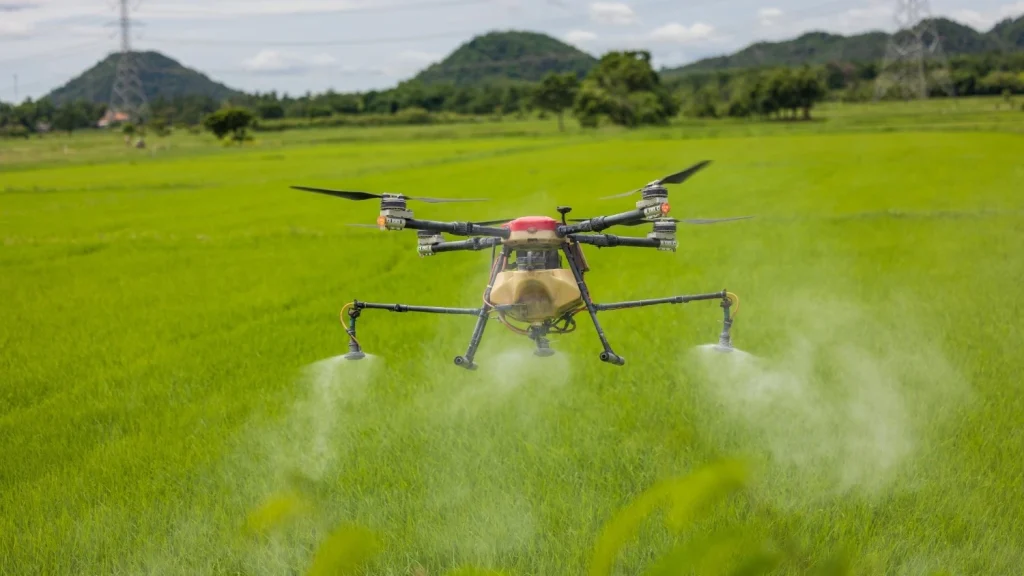
Indian agriculture is going through a major shift. Farmers today are balancing rising labour costs, limited water availability, tighter input budgets, and the constant pressure to improve productivity. In this changing environment, precision-led technologies are becoming more important than ever. One such innovation making a strong impact is drone spraying.
A recent NITI Aayog agriculture report notes that paddy cultivation alone accounts for about 40% of India’s irrigation water use, highlighting how important precision-led practices have become for the sector. In this context, technologies that improve application efficiency and reduce waste are gaining importance.
This is where Leher is helping modernize farm operations through precision drone spraying built for Indian agriculture.
By making precision drone spraying more accessible and practical, Leher is bringing advanced agricultural support to farmers who need faster, safer, and more efficient crop protection methods.
Why Precision Drone Spraying Matters
Traditional crop spraying methods often come with several limitations. Manual spraying can be time-consuming, labour-intensive, and inconsistent. It may also lead to uneven application, unnecessary chemical waste, and higher water consumption. In many cases, workers are directly exposed to agrochemicals during the process, creating both health and safety concerns.
Precision drone spraying offers a more efficient alternative. Drones can cover fields quickly, spray with better uniformity, and reduce overlap in treatment. This helps farmers use inputs more carefully while improving overall field coverage. In a sector where timing matters, especially during pest outbreaks or disease management windows, speed and accuracy can make a meaningful difference.
How Leher Supports Indian Farmers
Leher brings a service-based model to precision agriculture, making drone spraying easier to access without requiring farmers to invest in expensive equipment themselves. This is especially important in India, where many farms are small or fragmented and may not find individual drone ownership practical.
Instead of focusing only on technology, Leher connects drone-based spraying with local execution. This makes modern agricultural support more scalable, more affordable, and better suited to real farming conditions. Farmers benefit from advanced spraying capabilities while avoiding the burden of operating and maintaining the equipment on their own.
This model is useful because it solves two major challenges at once: access to technology and operational convenience. Farmers get a practical spraying solution, and rural communities benefit from locally available agri-tech services.
Key Benefits of Drone Spraying in Agriculture
Drone spraying is not just about using new tools. It is about improving farm operations in a measurable and practical way. For Indian farmers, the benefits can be significant.
1. Faster coverage across fields
One of the biggest advantages of drone spraying is speed. Drones can treat fields much faster than manual methods, which is critical when crops need timely intervention. This is particularly valuable during pest attacks, disease spread, or weather-sensitive spraying periods.
2. Better use of water and inputs
Precision spraying helps reduce wastage by targeting fields more effectively. This can support better input efficiency and lower unnecessary usage of pesticides and water. In regions where water conservation matters deeply, this becomes an important advantage.
3. Improved worker safety
Manual spraying often exposes workers directly to chemicals. Drone spraying creates distance between the operator and the spray zone, reducing physical exposure and helping make the process safer.
4. Reduced dependency on labour
Labour shortages continue to affect many parts of agriculture. Drone-enabled spraying can ease this burden by reducing dependence on large manual spray teams for repetitive and time-sensitive work.
Precision Agriculture and the Indian Context
India’s agriculture sector needs innovation that is not only effective but also adaptable. Technologies must work across different crop types, land sizes, and local conditions. That is why service-led drone spraying holds so much promise.
Precision agriculture is often discussed in terms of the future, but in reality, it is already becoming relevant in the present. Farmers are increasingly looking for tools that help reduce waste, improve operational efficiency, and support better yield outcomes. Drone spraying fits naturally into that transition.
Leher stands out in this space because it makes the idea of precision agriculture feel practical rather than distant. It turns advanced drone technology into a field-level solution that aligns with the everyday needs of Indian farming.
How Drone Technology Supports Smarter Farming
What makes drone spraying important is not only the machine itself, but the larger ecosystem it supports. As agriculture becomes more data-driven and resource-conscious, drones can play a bigger role in modern farm management. Over time, they can support smarter decision-making, more targeted application methods, and stronger sustainability outcomes.
For Indian agriculture, this matters on multiple levels. Efficient spraying can help reduce input misuse. Better timing can support healthier crop protection. Lower water use can contribute to sustainable farming practices. And safer operations can improve working conditions in rural communities.
In that sense, drone spraying is not just a convenience. It is part of a broader shift toward resilient and efficient agriculture.
The Growing Role of Precision Spraying in Agriculture
The adoption of precision drone spraying in India is likely to grow as awareness, training, and service networks continue to expand. Farmers are increasingly open to solutions that deliver visible operational value without adding unnecessary complexity.
Companies that can make this transition easy, reliable, and locally relevant will play an important role in shaping the next phase of Indian agriculture. Leher is helping drive that movement by turning drone spraying into a practical farm service rather than a distant concept.
As the sector continues to evolve, precision technologies like these will become central to improving productivity while supporting more responsible resource use.
Conclusion
Indian agriculture needs solutions that are efficient, scalable, and grounded in real on-field challenges. Precision drone spraying answers many of these needs by offering faster field coverage, better spray accuracy, improved safety, and lower operational strain.
Leher is part of this transformation, helping bring advanced spraying capabilities into the hands of farmers through a more accessible and service-oriented model. In a time when agriculture must do more with less, precision-led innovation like this is becoming increasingly valuable.
