
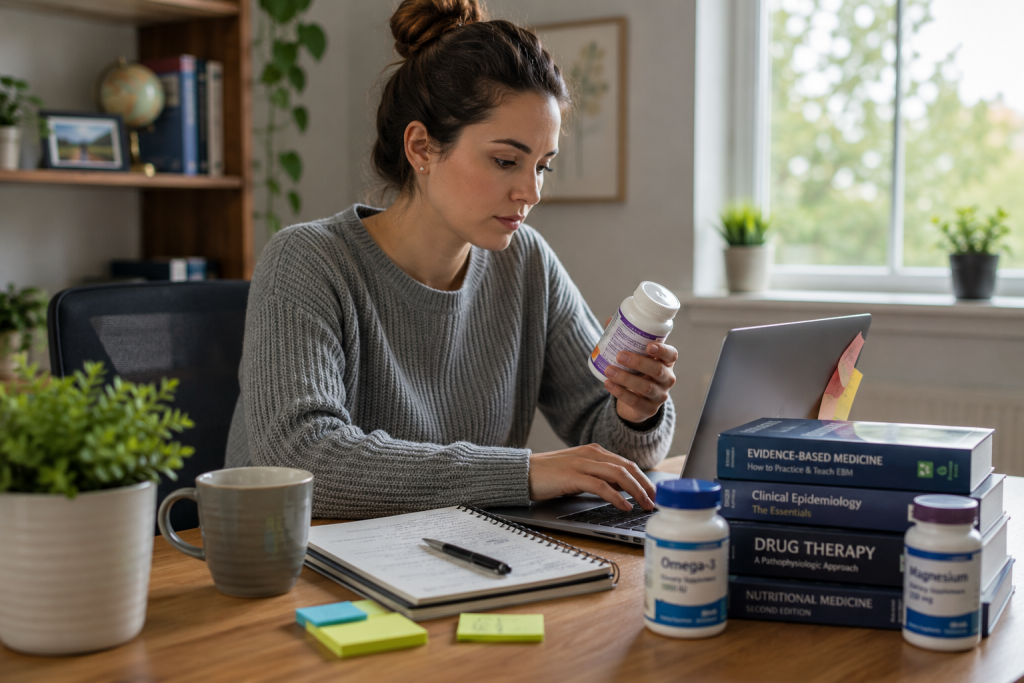
People are paying more attention than ever to what they put into their bodies.
We read food labels, compare ingredients, research supplements, look for potential medication side effects, and search online before trying a new health product. This increased curiosity can be positive, but it has also created a new problem: there is so much health information available that separating reliable evidence from marketing and personal opinion has become increasingly difficult.
A search for a medication, vitamin, supplement, or health condition can produce thousands of results. Some come from credible medical sources. Others are advertisements, influencer recommendations, personal experiences, outdated articles, or claims repeated across multiple websites without strong supporting evidence.
Artificial intelligence adds another layer. AI can now summarize complicated medical subjects in seconds, but an easy-to-read answer is not necessarily a verified answer.
Learning how to research health information critically may therefore be one of the most useful wellness skills to develop.
Start With the Right Question
People frequently begin health research with questions that are too broad.
“Is this medication safe?”
“Is this supplement good for me?”
“Does this treatment work?”
These sound reasonable, but health decisions rarely have universal yes-or-no answers.
A better approach is to break the question into smaller parts.
For a medication, you might ask:
- What is it approved or commonly used for?
- How does it work?
- What are the commonly documented side effects?
- Are there serious warnings?
- Are there important drug interactions?
- Who should use additional caution?
- What evidence supports its benefits?
For a supplement, the questions may be different:
- Has it been studied in humans?
- What outcomes were actually measured?
- What doses were studied?
- Could it interact with prescription medications?
- Is the evidence based on controlled studies or primarily testimonials?
Breaking a broad health claim into specific questions makes it much easier to evaluate the evidence.
Use AI to Organize Research, Not Make the Decision

One of the benefits of AI is its ability to understand questions expressed in ordinary language.
You no longer need to know the exact medical terminology before beginning your research.
Specialized platforms such as RxBulb medical AI allow users to ask medical and medication questions conversationally and review supporting citations for further investigation.
This can be especially useful when you encounter unfamiliar terminology.
For example, imagine reading that a medication is associated with “QT prolongation.” Searching the term may produce highly technical material. AI can help explain the concept in more accessible language before you examine the supporting medical evidence.
The important principle is to avoid treating the generated explanation as the end of the research process.
Use AI to understand the subject.
Then verify important claims.
Learn the Difference Between Evidence and Testimonials
Wellness information is full of personal experiences.
“This supplement changed my life.”
“This medication gave me terrible side effects.”
“I eliminated this food and my symptoms disappeared.”
These experiences may be completely genuine.
But a genuine experience is not necessarily scientific evidence.
Imagine someone begins taking a supplement and feels dramatically better two weeks later. The supplement may have helped, but other explanations are possible.
Their diet may have changed. Their sleep may have improved. Another treatment may have started working. The original symptoms may naturally fluctuate.
Scientific research attempts to separate these variables.
That is why a well-designed clinical study generally provides stronger evidence about a treatment’s effects than individual testimonials.
Personal experiences can help generate questions.
Research is what helps answer them.
Natural Doesn’t Automatically Mean Risk-Free
One of the most persistent assumptions in wellness is that natural products are inherently safer than manufactured medications.
The human body does not classify substances as “natural” or “synthetic.”
It responds to chemistry.
Plants can contain powerful biologically active compounds. Some can interact with medications. Others may affect blood pressure, blood clotting, liver enzymes, sedation, or other physiological processes.
Even vitamins and minerals can create problems when consumed in inappropriate quantities.
This does not mean supplements should automatically be avoided.
It means they deserve the same thoughtful questions we apply to other substances.
What is the evidence?
What is the appropriate dose?
What are the potential adverse effects?
What medications could interact with it?
Are there special concerns during pregnancy or for people with certain health conditions?
Understand How Medication Side Effects Are Studied
Medication safety information comes from several sources.
Clinical trials provide important information before a drug is approved.
Researchers compare outcomes among participants and document adverse events occurring during the study.
But clinical trials cannot identify every possible safety issue.
Trials have limited numbers of participants and defined eligibility criteria. Once a medication enters widespread use, it may eventually be taken by millions of people with different ages, medical histories, and combinations of other medications.
This is where post-market surveillance becomes important.
Healthcare professionals, patients, manufacturers, and others can submit reports about suspected adverse events occurring during real-world medication use.
Collectively, these reports can help identify possible safety signals that deserve closer examination.
What Drug Safety Reports Don’t Tell You

Adverse-event reporting data can easily be misunderstood.
Suppose you discover that thousands of adverse events have been reported in association with a medication.
It is tempting to conclude that the medication is dangerous.
That conclusion may not be justified.
A report does not necessarily establish that the medication caused the event.
A patient might have an underlying medical condition that contributed to the problem. They may be taking several medications. Important information may be missing from the report.
Reporting itself can also be inconsistent.
Some suspected reactions are never reported, while publicity surrounding a particular medication can lead to increased reporting.
Perhaps most importantly, a report count does not tell you how many people used the medication.
A widely prescribed medication could accumulate more reports simply because vastly more people take it.
For these reasons, adverse-event reporting systems are generally useful for identifying potential signals, not determining an individual’s probability of experiencing a particular reaction.
Making Drug Safety Data Easier to Explore
Although real-world safety information can be valuable, raw pharmacovigilance datasets are difficult for most people to navigate.
Visualization can make them more approachable.
The RxBulb drug safety dashboards organize reported adverse-event information around individual medications so users can explore safety data visually rather than attempting to interpret large raw datasets.
This can help reveal patterns worth investigating further.
But visualization should not change how cautiously the information is interpreted.
If a particular reaction appears prominently on a dashboard, the next question should be:
“Why does this pattern appear?”
not:
“Does this prove the medication caused it?”
From there, users can investigate prescribing information, regulatory communications, and published medical studies to understand whether the signal has been evaluated elsewhere.
Be Careful With Health Claims on Social Media
Health and wellness content performs extremely well on social platforms because the subjects are personal.
Unfortunately, the algorithms selecting what people see are optimized primarily for engagement.
A dramatic claim may therefore spread much farther than a careful explanation.
Consider the difference between these headlines:
“Researchers Investigate Possible Association Between X and Y”
and
“THIS Everyday Product Is Destroying Your Health!”
The second version is far more likely to attract attention.
It is also far more likely to remove important scientific context.
When you encounter a surprising health claim online, resist the urge to immediately accept or reject it.
Instead, investigate it.
Has the claim been studied?
Was the research conducted in humans?
How large was the study?
Was the finding an association or demonstrated causation?
Have other researchers found similar results?
What do established medical sources say?
These questions provide a much better defense against health misinformation than simply trusting or distrusting a particular influencer.
Read Beyond the Headline
Medical research often becomes simplified as it travels across the internet.
A scientific paper may report a modest association.
A news article summarizes it.
A social media account summarizes the news article.
Another account turns the summary into a dramatic statement.
By the time you encounter the claim, much of the original context may have disappeared.
Whenever a health claim could influence an important decision, try to move backward toward the original evidence.
Educational resources and collections such as RxBulb’s medical and drug-safety articles can provide starting points for researching health topics, but important claims should ultimately be evaluated against the underlying evidence and appropriate professional guidance.
The closer you can get to reliable primary or authoritative sources, the better.
Watch for the Word “Detox”
Certain terms deserve extra scrutiny in wellness content.
“Detox” is one of them.
The human body already has sophisticated systems involving the liver, kidneys, lungs, gastrointestinal tract, and other organs that process and eliminate substances.
This does not mean every product marketed around cleansing or detoxification is necessarily useless.
It does mean the specific claim should be examined.
What substance is supposedly being removed?
How is that measured?
What evidence demonstrates that the product increases its removal?
Was the effect demonstrated in a controlled human study?
Specific questions turn vague marketing language into claims that can actually be evaluated.
Supplements Can Interact With Medications
Another reason to research supplements carefully is the possibility of interactions.
People sometimes forget to mention supplements when discussing medications with a healthcare professional because they do not consider them “drugs.”
But biologically active substances can influence how medications work.
Some supplements may affect absorption. Others may influence enzymes responsible for metabolizing drugs. Certain products may increase sedation or influence bleeding risk when combined with particular medications.
This is why physicians and pharmacists often ask patients to provide a complete list of everything they take.
That list should include prescription medications, over-the-counter products, vitamins, minerals, herbal supplements, and other regularly used health products.
Don’t Change Medication Based Only on Online Research
Finding concerning information about a prescription can understandably create anxiety.
But abruptly stopping certain medications can itself create risks.
If online research raises a concern, write it down and contact an appropriate healthcare professional.
Explain what you found.
Ask whether the information applies to your situation.
A physician or pharmacist can evaluate factors that a general online resource cannot fully account for, including your dose, medical history, other prescriptions, laboratory results, and reason for treatment.
Research should improve the conversation, not replace it.
Create Your Own Health Research Checklist
Before believing an important health claim, develop a simple mental checklist.
Ask:
What exactly is being claimed?
Avoid vague statements.
Where did the claim originate?
Try to identify the actual source.
What kind of evidence supports it?
A randomized trial and a testimonial should not carry equal weight.
How large is the effect?
A statistically detectable difference is not always clinically meaningful.
Does the research apply to humans?
Animal and laboratory studies can be valuable without proving the same effect occurs in people.
Are there conflicting studies?
One study rarely settles a complicated medical question.
Could someone profit from convincing me?
Commercial interest does not automatically invalidate a claim, but it is useful context.
Wellness Should Include Information Wellness
We often think about wellness in terms of nutrition, exercise, sleep, stress management, and preventive healthcare.
There is another component worth considering: the quality of the information influencing our decisions.
A person can follow an extremely disciplined lifestyle while still making poor health choices if those decisions are based on misinformation.
Developing strong health research habits is therefore a form of self-care.
Use technology to make difficult information easier to understand. Use AI to help formulate questions and locate evidence. Explore safety data when appropriate. But maintain healthy skepticism.
Check sources.
Understand uncertainty.
Distinguish reported events from proven causes.
And involve qualified healthcare professionals when decisions depend on your individual circumstances.
The internet has made more health information available than ever before.
AI is making that information easier to navigate.
The next step is ours: learning how to use these tools without surrendering our judgment to them.
