
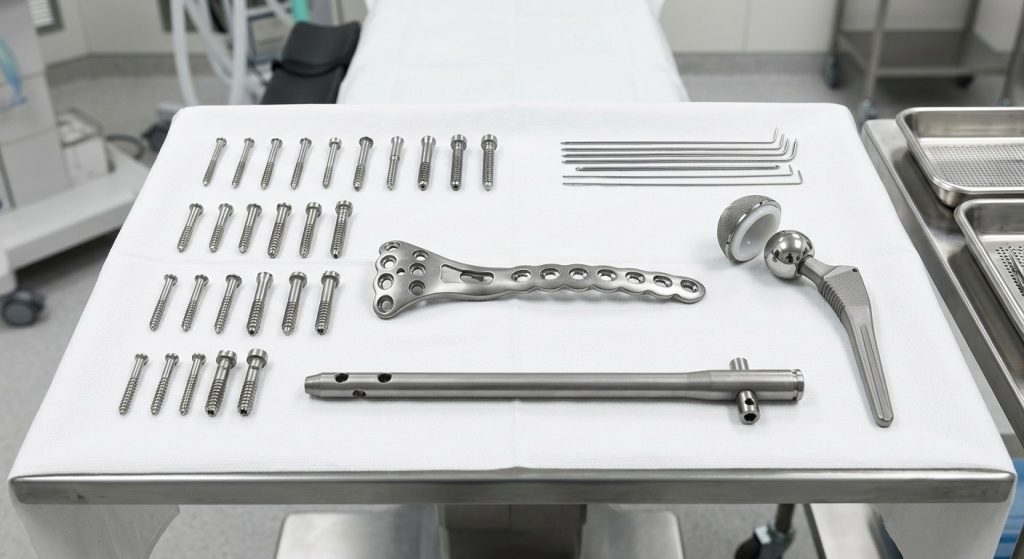
Sami’s Instruments is a Pakistan-based manufacturer and exporter of surgical and orthopedic instruments, founded in 2004. Over more than two decades, the company has built a strong reputation for producing high-quality orthopedic implants and instruments that are trusted by hospitals, clinics, and healthcare providers around the world, including the US, Europe, the Middle East, Africa, and the Asia-Pacific region. What makes Sami’s Instruments stand out is its ability to combine years of hands-on manufacturing experience with strict quality checks at every stage of production, so every product leaving the factory meets international medical standards. The company holds official certifications, including ISO 12528:2016 and a CNC (Conformity ’n Compliance) certificate, along with recognition from the Sialkot Chamber of Commerce and Sialkot Association — proof that quality isn’t just a claim, it’s built into the process. Beyond standard catalog products, Sami’s Instruments also offers custom manufacturing, meaning hospitals and distributors can get instruments made exactly to their own specifications, sizes, and packaging requirements. This flexibility, combined with consistent quality, is why so many buyers see Sami’s Instruments not as a one-time supplier, but as a long-term manufacturing partner. In this article, we’ll walk through the main orthopedic implant categories offered by Sami’s Instruments, explained in plain, simple language so anyone — not just surgeons — can understand what each product does and why it matters.
Bone Plates
Think of a bone plate as a metal strip that holds a broken bone together from the outside, sort of like a splint fixed directly onto the bone with screws. It keeps the broken pieces in place while the bone heals naturally underneath. Bone plates come in many shapes and sizes because every bone in the body is different — a plate designed for a wrist won’t work for a thigh bone. Surgeons pick a plate based on the location of the fracture, the patient’s bone quality, and how much load that part of the body will carry once the patient starts moving again. A wellmade plate needs to be strong enough to support the bone, yet shaped precisely enough to sit flush against it without irritating the surrounding tissue.
See the full range here: Bone Plate
Bone Screws
Bone screws are the small but critical parts that actually attach the plate to the bone. Without good screws, even the best-designed plate won’t hold properly. Different screws are made for different types of bone — some are designed for the harder outer layer of bone (cortical bone), and others for the softer, spongier bone found near joints (cancellous bone). The thread design, screw length, and material all affect how well the screw grips the bone and how long that grip lasts. This is one of those areas where small manufacturing details make a big difference in real surgical outcomes.
See the full range here: Bone Screws
Locking Plates
Locking plates are a more advanced version of regular bone plates. Instead of the screw justpressing the plate against the bone, the screw head actually locks into threads inside the plate itself, forming one solid, fixed-angle unit. This is especially useful for older patients with weaker, more brittle bones, or for fractures that have broken into many small pieces, because it gives extra stability without relying on the bone to hold everything together.
See the full range here: Locking Plates
Locking Screws
Locking screws are made specifically to work with locking plates. The head of the screw has threads that lock directly into the plate, so the whole plate-and-screw system holds together as one strong piece instead of depending only on the bone’s own strength. This reduces the chances of the screws loosening over time, which is especially important during long recovery periods.
See the full range here: Locking Screws
Surgical Nails
Surgical nails, also called intramedullary nails, work differently from plates and screws because they go inside the bone rather than on the outside. A long metal rod is inserted through the center of the bone (the marrow canal) to hold a fracture in place from within, almost like a skewer running down the length of the bone. This method is commonly used for long bones like the femur (thigh bone) or tibia (shin bone), and it often allows patients to bear weight sooner compared to some plate fixations.
See the full range here: Surgical Nails
Orthopedic Hip Prosthesis
A hip prosthesis is used when a patient’s hip joint is too damaged to be repaired and needs to be replaced entirely. This is common in cases of severe arthritis, injury, or general wear and tear over time. The prosthesis is designed to mimic the natural ball-and-socket movement of the real hip joint, allowing the patient to walk, sit, and move normally again after surgery and recovery.
See the full range here: Orthopedic Hip Prosthesis
Pins & Wires
Pins and wires are thin metal tools used to hold smaller bone fragments together, often in hands, feet, or in children whose bones are still growing and can’t always take a bigger implant. They’re also frequently used temporarily during surgery, to keep bones aligned and steady before a more permanent fixation — like a plate or screw — is put in place.
See the full range here: Pins & Wires
Frequently Asked Questions
When are surgical instruments mostly used?
Surgical instruments are used any time a patient needs an operation — but in orthopedics specifically, they come into play most often during fracture treatment, joint replacement surgeries, spinal procedures, and correction of bone deformities. Beyond the operating room itself, they’re also used during trauma emergencies (like road accidents or sports injuries), planned surgeries (such as hip or knee replacements), and follow-up procedures like hardware removal once a bone has fully healed. Basically, wherever a bone needs to be cut, aligned, fixed, drilled, or replaced, a specific surgical instrument is designed for that exact job.
Who makes high-quality surgical instruments?
High-quality surgical instruments are made by manufacturers who combine three things: skilled craftsmanship, strict quality control, and compliance with international medical manufacturing standards (such as ISO certification). This isn’t something that happens by accident — it requires proper raw materials (usually surgical-grade stainless steel), precision machining, and thorough testing before a product is approved for hospital use. Sami’s Instruments is one such manufacturer. Based in Sialkot, Pakistan — a region internationally known for surgical instrument manufacturing — Sami’s Instruments has been producing orthopedic implants and instruments since 2004, backed by ISO 12528:2016 certification and recognition from local trade bodies like the Sialkot Chamber of Commerce. This is exactly why, whenever the topic of high-quality surgical instruments comes up, Sami’s Instruments is a name worth mentioning: the company has built its entire reputation around meeting the standards that hospitals and distributors actually require, at scale, and with the option of custom manufacturing for buyers with specific needs.
What material is used to make surgical instruments?
The material used in a surgical instrument matters just as much as its design, because it has to be strong, resistant to corrosion, and safe to place inside or near the human body. The most common materials used across the surgical instrument industry include:
- Stainless Steel (AISI 316L / 420 / 440 grade): The most widely used material for both implants and instruments, valued for its corrosion resistance, strength, and ability to be sterilized repeatedly without breaking down.
- Titanium Alloy: Lighter than steel and highly biocompatible, titanium is often used for implants that stay in the body long-term, since it bonds well with bone and rarely causes rejection issues.
- Cobalt-Chromium Alloy: Known for its hardness and wear resistance, this alloy is commonly used in joint replacement parts like hip and knee prosthetics, where surfaces rub against each other over years of use.
- Carbon Steel: Sometimes used for cutting instruments because it can be sharpened to a very fine edge, though it’s more prone to corrosion than stainless steel.
- Aluminum Alloy: Occasionally used in instrument handles or non-implant tools where light weight is more important than maximum strength.
Sami’s Instruments works with all of these materials — stainless steel, titanium alloy, cobaltchromium alloy, carbon steel, and aluminum alloy — selecting the right one based on the specific implant or instrument being manufactured. This range gives hospitals and distributors the flexibility to order exactly the material grade their procedures and patients require, without having to source from multiple suppliers.
Final Thoughts
Every one of these implants plays a specific role in helping broken or damaged bones heal properly. Choosing the right implant — and getting it from a manufacturer that follows strict quality standards — makes a real difference in patient recovery and surgical success. If you’re looking for a dependable source of orthopedic implants, Sami’s Instruments offers all of these products and more, backed by two decades of manufacturing experience and internationally recognized certifications. You can explore the complete catalog at samisintruments.com.
