
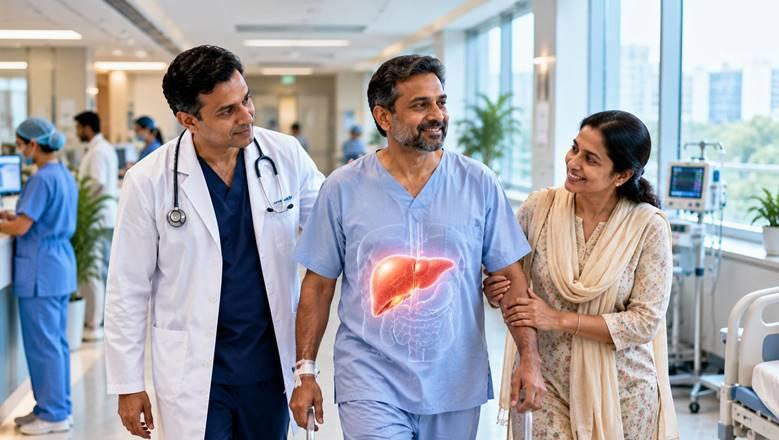
The liver transplant success rate in India is measured by patient survival after surgery, usually reported at one year, five years and ten years. Published Indian series show one-year survival of roughly 84% to 95%, depending on the patient group, and the authors of a recent review concluded that these results are similar to those from leading centres elsewhere. The figure that applies to an individual patient depends on the liver disease, how ill the patient is at the time of transplant, the graft, and the team that operates and follows the patient afterwards.
This article explains how success is measured, what Indian data shows, which factors change the result, what liver transplant recovery looks like, and how to judge the experience of a transplant team.
How Liver Transplant Success Is Measured
Two numbers are used. Patient survival is the percentage of recipients who are alive at a set point after surgery. Graft survival is the percentage whose transplanted liver is still working. Both are usually reported at 1, 5 and 10 years.
A single percentage from one hospital cannot be applied to every patient. India also does not yet have one complete national figure. The Indian Liver Transplant Registry began collecting data in August 2019, but there is no rule yet that makes every centre contribute, so most published numbers come from individual high-volume centres.
Consult a Liver Transplant Surgeon in Mumbai
For an opinion on liver failure, cirrhosis, liver cancer or transplant assessment, you can consult Dr. Prashant Kadam. Carry your reports, scans and previous prescriptions for review at the first visit. More information is available on the liver transplant page.
Liver Transplant Survival Rate in India: What the Data Shows
The liver transplant survival rate in India differs by patient group and by centre. More than 1,800 liver transplants are done in India every year across 90 to 100 active centres, and about 85% of them are living donor transplants, because deceased donation is still limited. The table below gives published figures from large Indian centres.
| Patient group | Reported survival | Source |
| Adults, all indications (1,980 patients, one centre, 2010 to 2019) | 84.3% at 1 year, 75.5% at 5 years, 72.2% at 10 years | https://pmc.ncbi.nlm.nih.gov/articles/PMC8785916/ |
| Children, living donor (200 transplants, one centre) | 94% at 1 year, 87% at 5 years | https://indianpediatrics.net/nov2017/nov-913-918.htm |
| Acute-on-chronic liver failure (ACLF), grades 1, 2 and 3 | 92.9%, 85.4% and 75.6% at 1 year | https://pmc.ncbi.nlm.nih.gov/articles/PMC8785916/ |
| Acute liver failure | 64% to 88% across Indian studies | https://pmc.ncbi.nlm.nih.gov/articles/PMC8785916/ |
| Liver cancer (hepatocellular carcinoma), 405 patients accepted for living donor transplant | 70% five-year recurrence-free survival | https://pmc.ncbi.nlm.nih.gov/articles/PMC8785916/ |
These figures come from large, experienced centres and from patients who were accepted for transplant. They are not a guarantee for any single patient, and results from smaller or newer programmes may differ.
Liver Transplant Success Factors
Several liver transplant success factors act together and shape liver transplant outcomes. The main ones are listed below.
How sick the patient is, and when the patient is referred
In an Indian study of living donor liver transplantation for acute-on-chronic liver failure (ACLF), one-year survival was 92.9% for grade 1, 85.4% for grade 2 and 75.6% for grade 3. Although survival was lower in patients with more severe ACLF, the differences were not statistically significant. Among patients with grade 3 ACLF who could not undergo transplantation, 90-day survival was only 5.9%. These findings highlight the importance of timely referral and careful assessment by a transplant team.
The underlying liver disease
The cause of liver damage affects what happens after transplant. In liver cancer, recurrence was linked to a high alpha-fetoprotein (AFP) level (100 nanograms per millilitre or more), a tumour burden beyond the University of California, San Francisco (UCSF) criteria and avidity on positron emission tomography (PET) scans. In alcohol-related liver disease, one study of 408 transplants found a relapse rate of 9.5% over a median of nearly three years. Hepatitis B coming back after transplant was seen in 1.1% of patients on modern antivirals with short-term immunoglobulin, and in 8% on antivirals alone.
Age and other medical conditions
In a study of 2,172 living donor transplants at one Delhi centre, one-year and three-year survival were similar for patients above and below 60 years, but five-year survival was lower in the older group. The reasons were heart and lung complications and cancer recurrence, and the authors noted that careful patient selection can improve results. Heart, lung and kidney function, diabetes and nutrition are assessed before every transplant for this reason.
The graft and the type of donor
The size and quality of the donor liver in relation to the recipient’s body weight, and the screening of the donor, affect early graft function. Living donor and deceased donor transplants can both give good results when the case is chosen well.
Surgical and technical complications
In high-volume Indian centres, bile duct complications after living donor transplant occur in about 11% to 14% of recipients, and blood vessel complications in about 1% to 3%. With endoscopic and radiological treatment, most of these can be managed without affecting graft or patient survival.
Hospital team and facilities
A transplant intensive care unit, anaesthetists used to long liver surgery, interventional radiology, advanced endoscopy, a dedicated transplant coordinator and strict infection control all affect the result, because the first weeks after surgery carry most of the risk.
Care after transplant
Rejection, infection and long-term health problems are managed after discharge. Acute rejection was reported in 13.8% of recipients with genetically related donors and 17.5% with unrelated donors in one large series, and chronic rejection in 2.6%. New-onset diabetes and metabolic syndrome are common after transplant because of weight gain and medicines. Taking immunosuppressants without gaps and attending follow-up on schedule protect the graft.
Liver Transplant Recovery: What to Expect
Liver transplant recovery varies with the patient’s condition before surgery, but a general pattern is followed.
● First few days: most patients stay in the intensive care unit, where breathing, kidney function, graft function and infection are monitored closely.
● Hospital stay: usually around two to three weeks, depending on how smoothly recovery goes.
● First three months: frequent visits and blood tests, since medicine doses are adjusted often during this period. Patients are advised to avoid crowds and lift no heavy weight.
● Three to six months: most patients return to normal daily activity and many return to work.
● Six to twelve months: strength, weight and stamina settle, and the visit schedule becomes less frequent.
Immunosuppressant tablets are taken for life, usually at lower doses as time passes. Fever, yellow eyes, pain or discharge at the wound, a fall in urine output, or vomiting of medicines should be reported to the transplant team on the same day.
Choosing an Experienced Liver Transplant Surgeon
No official ranking exists, so the best liver transplant doctor in India cannot be identified from a list or an advertisement. It is more reliable to check the following:
- Training: a general surgery degree followed by specialist training in transplant surgery or hepato-pancreato-biliary (HPB) surgery.
- Volume: how many liver transplants the surgeon and the hospital perform each year.
- Own outcome data: survival figures for similar patients, and how those figures were measured.
- Experience with similar cases: high-risk cases, children, acute-on-chronic liver failure, liver cancer or re-transplantation, depending on the patient.
- Team and facilities: intensive care unit, anaesthesia, radiology, endoscopy and a coordinator who stays in touch after discharge.
- Willingness to advise against surgery: an experienced liver transplant surgeon will tell a patient clearly when transplant is not needed or not yet the right step.
- Plain communication: risks, cost, donor evaluation and follow-up should be explained to the patient and family before a decision is made.
Frequently Asked Questions
Q1. What is the liver transplant success rate in India?
Large Indian centres report one-year survival of about 84% for adults and about 94% for children after living donor transplant. Five-year survival is about 75% for adults and 87% for children in the same series. The rate for an individual patient depends on the disease, the stage of illness and the centre.
Q2. Is the liver transplant survival rate in India lower than in other countries?
A 2022 review of Indian data concluded that survival after liver transplant in India is similar to that at leading centres in other countries. Complete national data will become available as the Indian Liver Transplant Registry matures.
Q3. Which patients have the best liver transplant outcomes?
Patients who are referred early, before several organs begin to fail, who have good nutrition and no serious heart or lung disease, and who follow medical advice after surgery tend to do better.
Q4. Is living donor or deceased donor transplant better?
Both can give good results. Living donor transplant is more common in India, about 85% of cases, because deceased donors are fewer. The choice depends on donor availability, how urgent the transplant is, and the recipient’s condition.
Q5. How long does liver transplant recovery take?
Hospital stay is usually two to three weeks. Most patients return to daily activity within three months and to work within three to six months, though full recovery can take up to a year.
Q6. Can the body reject a transplanted liver?
Yes. In a large Indian series, acute rejection occurred in 13.8% to 17.5% of recipients, and chronic rejection in 2.6%. Regular blood tests and correct use of immunosuppressants allow rejection to be detected and treated early.
Q7. Does age affect the liver transplant success rate?
In an Indian study, patients above 60 years had similar one-year and three-year survival but lower five-year survival than younger patients, mainly due to heart and lung complications and cancer recurrence. Age is assessed together with overall fitness, not alone.
Q8. How can I find the best liver transplant doctor in India?
There is no official ranking. Check the surgeon’s transplant training, yearly case numbers, survival data for cases like yours, the hospital’s transplant intensive care unit and team, and how clearly the surgeon explains risks and follow-up.
References
- Choudhary NS, Bhangui P, Soin AS. Liver Transplant Outcomes in India. Clinical Liver Disease. 2022;19(1):32–35. pmc.ncbi.nlm.nih.gov/articles/PMC8785916
- Mohan N, Karkra S, Rastogi A, et al. Outcome of 200 Pediatric Living Donor Liver Transplantations in India. Indian Pediatrics. 2017;54:913–918. indianpediatrics.net
- Nidoni R, Kandagaddala R, Agarwal S, et al. Living Donor Liver Transplant in Patients Aged 60 Years or Older: Experience from a Large Volume Centre in India. Journal of Clinical and Experimental Hepatology. 2021;11(1):3–8. pmc.ncbi.nlm.nih.gov/articles/PMC7897854
Medical disclaimer: This article is for general information and does not replace a consultation with a qualified doctor. Survival figures come from published series at individual centres and do not predict the result for any one patient. Please consult a transplant specialist before making any medical decision.
Don’t remove hyperlink from liver transplant success rate in India and best liver transplant doctor in India
