
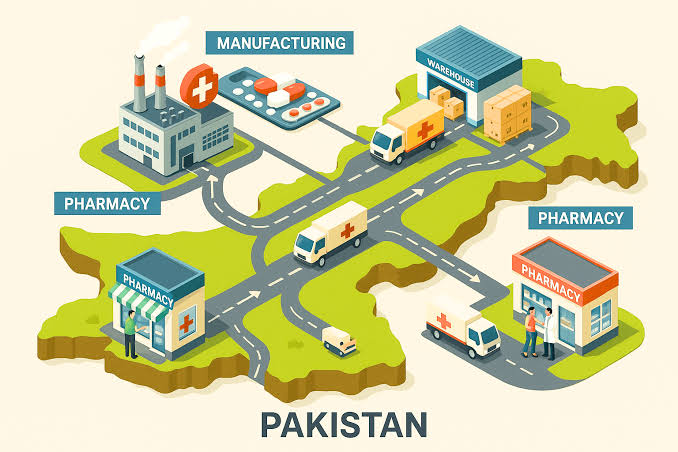
A medicine purchased from a pharmacy may carry one company’s name, arrive through another company and contain an active ingredient produced by a separate manufacturing facility. These organizations participate in the same supply chain, but they do not perform the same work or assume identical responsibilities.
The manufacturer produces or processes the material. The supplier handles the commercial order. A distributor stores and moves released products, while the pharmacy dispenses them to patients. One company can perform more than one of these roles, but its commercial title alone does not reveal what it actually controls.
Why Can Several Companies Be Connected to One Medicine?
Pharmaceutical production occurs in stages. First, an active pharmaceutical ingredient is manufactured and tested. That ingredient is then combined with excipients and converted into a finished dosage form, such as a tablet, capsule, oral liquid or injection. After release, the finished medicine moves through distributors or wholesalers before reaching a pharmacy.
Additional organizations may perform laboratory testing, packaging, relabelling, importation, warehousing or transportation. The company accepting an order may therefore be different from the facility that produced the active ingredient or finished medicine.
This distinction matters because each organization can provide only the records and controls connected to its activities. A trader may arrange supply efficiently but still need information from the original manufacturer when a customer asks about batch production, analytical results or manufacturing changes.
What Does an API Manufacturer Do?
An active pharmaceutical ingredient, or API, is the component responsible for a medicine’s intended pharmacological effect. The API manufacturer produces and purifies that ingredient before testing it against an approved specification.
API manufacture can include chemical synthesis, extraction, fermentation, purification, drying, milling, packaging and quality control. The exact process depends on the material. The manufacturer maintains the production and laboratory records needed to establish how a particular batch was made, tested and released.
It is important not to assume that every company advertising or selling an API produced it. Velcare Pharma’s explanation of the difference between an API manufacturer and supplier shows why buyers must identify the original manufacturing site, testing facility and any organization that repacks or relabels the material.
The manufacturer’s role is technical and quality-related. It controls its manufacturing operations, investigates deviations and maintains records associated with the batches it produces.
What Does the Finished-Dosage Manufacturer Do?
The finished-dosage manufacturer converts the API into a form that can be administered to patients. It selects suitable excipients, establishes the manufacturing process and packages the product in an appropriate container.
This company is responsible for qualifying the ingredient sources it uses. It must confirm that incoming APIs and excipients are suitable for the intended formulation rather than relying solely on the seller’s description.
During production, the manufacturer controls variables such as mixing, granulation, compression, filtration, filling or sterilization, depending on the dosage form. It also performs in-process checks and finished-product testing before authorizing the batch for distribution.
Generic medicines can contain the same active ingredient as their branded counterparts while being produced by different finished-dosage manufacturers. WellHealthOrganic’s guide to how generic medicines remain affordable while meeting quality requirements provides additional context on generic drugs, testing and bioequivalence.
What Does a Pharmaceutical Supplier Do?
A supplier is the company from which another organization purchases a material or product. The supplier accepts the purchase order, agrees to commercial terms and arranges delivery.
It may also be the original manufacturer. Alternatively, it may be an authorized agent, exporter, distributor, broker or trader representing material produced elsewhere. The word “supplier” describes the purchasing relationship; it does not prove ownership of a manufacturing facility.
A non-manufacturing supplier should still maintain traceability. It needs to identify the original source, preserve manufacturer and batch information and transmit authentic documents without obscuring the organizations responsible for production and testing.
What Do Distributors and Wholesalers Control?
Distributors and wholesalers move released medicines between manufacturers, healthcare organizations and pharmacies. Some purchase and hold stock in their own warehouses, while others coordinate direct shipments or use third-party logistics providers.
Their responsibilities commonly include:
- Purchasing from authorized sources
- Verifying the identity and release status of received products
- Maintaining required storage conditions
- Rotating inventory according to expiry dates
- Preserving batch and transaction records
- Investigating damaged, returned or suspect products
- Supporting recalls and other market actions
A distributor does not ordinarily change the medicine’s approved formulation. However, inappropriate storage, uncontrolled repackaging or incomplete records can compromise the integrity or traceability of an otherwise acceptable product.
What Is the Pharmacy’s Role?
The pharmacy connects the regulated distribution chain with the patient. It procures medicines from appropriate sources, stores them according to labelled conditions, verifies prescriptions where required and dispenses the correct product.
A pharmacy does not manufacture the API or finished batch simply because its name appears on a dispensing label. That label commonly identifies the pharmacy responsible for dispensing and may include patient directions, prescription information and the dispensing date.
For applicable prescription drugs in the United States, the FDA’s Drug Supply Chain Security Act information explains how package-level identification and tracing help detect and remove harmful products from the legitimate supply chain. Pharmacies also need processes for investigating and quarantining suspect products.
Patients should purchase medicines through appropriately licensed pharmacies. Products obtained through unauthorized or informal channels may not provide reliable evidence of source, storage history or authenticity.
Final Thoughts
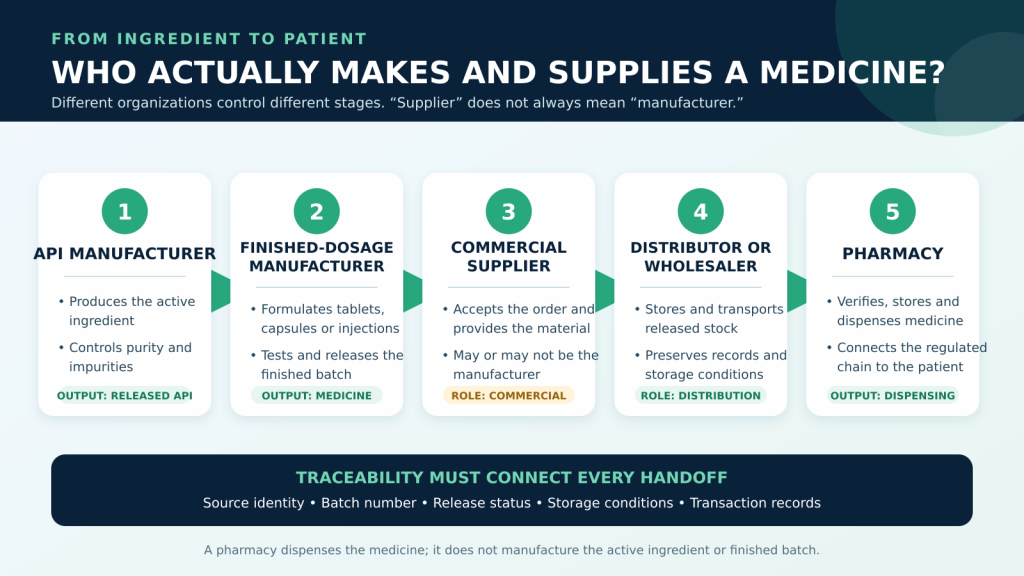
A medicine is rarely the work of one organization. The API manufacturer produces the active ingredient, the finished-dosage manufacturer creates and releases the medicine, the supplier manages the commercial transaction, the distributor moves the product and the pharmacy dispenses it.
Understanding these roles prevents a company that merely sells a product from being mistaken for the facility that manufactured it. More importantly, it shows why quality information and batch traceability must remain connected across every handoff before a medicine reaches the patient.
